Showing posts with label Christopher Lee. Show all posts

Friday, 14 November 2025

The Magic Christian (3 Stars)


I decided to watch this film after it was recommended by Fred Olen Ray. I knew very little about it in advance, except that it's considered a cult film. But still, I was shocked by the content, and not in a good way.

The film begins with a portrait of the Queen while the National Anthem is being played. Then the camera zooms out to show that the picture is a ten pound note. That was a lot of money in 1969. It's the equivalent of 1760 pounds today. The film's message is that people will do anything for money, but there's so much absurd humour that the message is often forgotten.

Sir Guy Grand (Peter Sellers) is a billionaire industrialist. He regrets not having an heir to his fortune, so he adopts a homeless man that he sees in the park (Ringo Starr). Surprisingly, Youngman (that's the man's name) easily fits in with the better social life.


Is this supposed to be London? It's a dank, gloomy town.


Father and son take a journey on a cruise ship, the Magic Christian.


There's a vampire on board.


Raquel Welch is cracking a whip, surrounded by dozens of topless women. It's only a short scene, worthy of a pause and repeat.


Roman Polanski has a cameo as a man sitting in the bar looking bored.

In fact, the film has so many cameos that you need a scorecard to keep up with them. There are famous actors like Richard Attenborough and Yul Brynner, as well as just about every British comedian of the 1960's.

But the film is a mess. I can't understand why it's called a cult film.

Order from Amazon.co.uk
Order from Amazon.de

Saturday, 21 September 2024

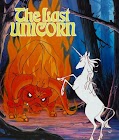
The Last Unicorn (4 Stars)


A unicorn lives in a forest which is blessed by her presence. It's always spring, never too cold, never too warm. She wonders why there are are no other unicorns, until a butterfly tells her that she's the last of her kind. A red bull has driven the unicorns away, possibly to their death. The unicorn decides to leave the forest to find out if the oher unicorns are still alive. This is a risk for her. In the forest she's immortal, but when she leaves it she can be killed.

So she goes on a journey to find the red bull which is supposedly the servant of King Haggard. She's surprised to discover that nobody recognises her as a unicorn. People no longer believe in unicorns, so they don't see her horn and assume she's a horse.

When she encounters the red bull he wants to kill her, so a magician saves her by turning her into a beautiful woman. King Haggard's son falls in love with her. So what's more important? Finding true love or finding her fellow unicorns?

This is a delightful film that appeals to both children and adults.

Order from Amazon.com
Order from Amazon.co.uk
Order from Amazon.de

Sunday, 5 November 2023

Dracula (1958 version) (5 Stars)


While watching "Dracula" today I wondered how it was received in 1958 when it was first released. Were the audiences prepared for what they saw? Did they know Bram Stoker's novel, of were they only acquainted with the 1931 film version? The purists who knew the book must have been shocked. So many things have been changed. It's not just deliberate changes, such as the film taking place in Bavaria instead of England. There are also blunders, such as getting the names of Mina and Lucy mixed up. Compared with the novel, the 1958 Dracula film is a mess. And yet, if judged on its own merits, it's a masterpiece. Christopher Lee is terrifying, much more than Bela Lugosi.


It's terrifying to see Christopher Lee appear at the top of the stairs. He's an imposing figure.


It's also terrifying to see him at the door.


Peter Cushing was the ideal choice to play Doctor Van Helsing. (We aren't told his first name in the film). He's a perfect gentleman in clothing and manners. His quiet, polite manners conceal the fact that he's capable of staking sleeping vampires without hesitation.

Christopher Lee and Peter Cushing are usually mentioned in the same breath by horror fans. They appeared in more than 20 films together, most of them horror films. In my opinion, their best joint performance was as Count Dracula and Doctor Van Helsing. Their respective performances bounce off one another.

Despite strongly deviating from the novel, this is one of the most powerful vampire movies ever made.

Success Rate:  + 13.4

Order from Amazon.com
Order from Amazon.co.uk
Order from Amazon.de

Wednesday, 15 March 2023

The Four Musketeers (1974) (4 Stars)


This is a sequel to "The Three Musketeers", made a year earlier. Actually, both films were made together. The intention was to release them as a single film, but during production it was decided the resulting film would be too long, so they were split into two.

That's what I've read, but it's not the impression I get when watching the films. They have distinct styles. Both films have a lot of comedy, but in the first film the swordfights are slapstick comedy, whereas the swordfights are more realistic in the second film. The second film also seems to have a bigger budget, based on the extravagant battle scenes and the increased number of extras.

The background of "The Four Musketeers" is a battle in La Rochelle between the Catholics and the Protestants. The Musketeers have divided loyalties. On the one hand, they're servants of the king and faithful Catholics. On the other hand, their friend the Duke of Buckingham is allied with the Protestant rebels. As they mockingly say to one another, "We're at war to decide whether psalms should be sung in French or Latin. But isn't that what all religious wars are about?" 

The Queen of France has ended her affair with the Duke of Buckingham, but she doesn't want him to be killed in a war between France and England. It's common knowledge that she's friends with her dressmaker Constance Bonacieux, who's also D'Artagnan's lover. On the instructions of Cardinal Richelieu, Milady de Winter seduces D'Artagnan to break up the connection, but D'Artagnan rejects her. She feels insulted and wants D'Artagnan dead at all costs.


It's interesting how the film is wrapped around historical events. The Duke of Buckingham was assassinated by an English soldier called John Felton on 23rd August 1628. The film shows that he was persuaded to kill him after being seduced by Milady de Winter, a person who never existed in real life.

I've given both films the same rating, but I think I slightly prefer "The Four Musketeers". There's more action, which appeals to me.

Order from Amazon.co.uk
Order from Amazon.de

Friday, 3 March 2023

The Three Musketeers (1973) (4 Stars)


"The Three Musketeers" is one of the most filmed novels ever. Supposedly it's been filmed over 50 times, which makes it second only to Bram Stoker's "Dracula". Which is the best version? I don't know. Ask me when I've watched the other 49 or more versions.

The 1973 version keeps close to the book, but it concentrates on humour rather than action. After years of swordsmanship training with his father, young D'Artagnan goes to Paris to become a musketeer. I have one problem understanding this. A musketeer was a rifleman, and we even see a rifle presented to D'Artagnan when he's accepted, but the so-called musketeers always use swords to fight. Is this explained in the novel?

In Paris hot-headed D'Artagnan gets into arguments with strangers who challenge him to duels. These strangers are the Three Musketeers, who he meets separately: Athos, Porthos and Aramis. When he's about to begin his first duel, they're interrupted by Cardinal Richelieu's guards. Duelling in the streets is illegal. D'Artagnan joins the Three Musketeers in a battle with the soldiers, so the four of them become friends.

The king's wife has had an affair with the English Duke of Buckingham. She tells him they can no longer see one another. She gives him her diamond necklace as a parting gift. That's foolish, because it was a present from her husband, and he tells her he wants her to wear it at the next royal ball. The queen gives D'Artagnan the secret mission to travel to England and retrieve the necklace before the ball takes place.

I enjoyed this film, which I saw today for the first time, but it seems dated in comparison with the 1993 version, which I've seen a few times.

Success Rate:  + 0.2

Order from Amazon.co.uk
Order from Amazon.de

Tuesday, 31 May 2022

Hannie Caulder (4 Stars)


A British spaghetti western? Is that a contradiction? Let's put it differently: "Hannie Caulder" is a British western made in the style of spaghetti westerns. It was even filmed in the Spanish region of Almeria.

The film takes place on both sides of the border between the USA and Mexico. The date isn't stated, but in a cemetery we see a tombstone dated 1874, so I assume it's the late 19th Century. A gang of inept bank robbers, the Clemens Brothers, botch a bank robbery in Mexico, killing people but not taking any money. They flee across the border and arrive at the horse farm where Hannie Caulder lives. They shoot her husband, rape her and set her house on fire. She swears revenge, but how can she do anything by herself?


A bounty hunter called Thomas Price passes her farm, asking if his horse can have water from her well. She tells him what happened and asks him to teach her how to shoot. At first he refuses, but when he sees how determined she is he's worried that she'll get herself killed if she isn't trained.


Price travels with her to Mexico to visit a gunsmith called Bailey, played by Christopher Lee. He lives by the sea with a Mexican wife and his children. His only visitors are men who want to have their guns repaired. He makes a new gun specially adapted to Hannie's size and strength, a light gun that still has enough power to kill at close range.

When they return to America they find the Clemens Brothers in a small border town. Price wants to capture one of them to claim the reward. He kills him, but he's badly injured in the fight, so Hannie has to tackle the other two brothers by herself.


Most film critics don't like the film, but it has one big fan: Quentin Tarantino. He says that it was one of his main inspirations for "Kill Bill". The relationship between the Bride and Pai Mei is based on Hannie Caulder and the bounty hunter. There's also a parallel between the gunsmith and Hattori Hanzo.

But what do I think about the film? I have mixed feelings. It's a good story, but it's spoilt by the comic elements. The Clemens Brothers are stupid, and whenever we see them we have to laugh. The film would have been better if the Clemens Brothers had been efficient cold-blooded criminals. It would have made Hannie's victory over them more meaningful.

Raquel Welch is beautiful as Hannie Caulder, but she doesn't dress as sexily as she looks in the poster at the top of this post. She's always wearing tight leather trousers.

Order from Amazon.com
Order from Amazon.de

Tuesday, 12 April 2022

To the Devil a Daughter (5 Stars)


This will probably be a short review. I've had a bad flu since Sunday. The worst day was yesterday, but I still have a 38.5 fever. Yesterday was horrible. Every time I closed my eyes I was delirious. I saw patterns moving across my vision.

And before anyone asks if it's Corona, the answer is No. I tested myself a week ago before my son Benjamin came to visit, and I tested myself again today. It's a good old-fashioned flu. And I hate it.

This was the last Hammer Horror film, made in 1976. It was universally criticised, including by Dennis Wheatley, on whose book the film was based. I find that unfair. It stars Christopher Lee at his most sinister, and Nastassja Kinski as the appealingly innocent young virgin.


Christopher Lee plays Father Michael Rayner, a Catholic priest who was excommunicated for heresy. After leaving the church he founded a new church, the Children of the Lord, which looked outwardly identical to the Catholic Church. The main difference is that the Lord they follow isn't God, it's the Demon Astaroth. Father Michael has a complex plan to bring Astaroth to Earth in the form of a woman. First a baby girl has to be born on Halloween and baptised with blood. On her 18th birthday she has to be baptised again with the blood of the new-born Astaroth, after which she will become Astaroth.

The 18-year-old girl is Catherine Beddows, played by Nastassja Kinski. Her father tries to protect her by putting her in the care of the American expert on the occult, John Verney, but Father Michael has great psychic powers and can call Catherine from afar.


This is Astaroth, who was born two days before Catherine's birthday. I have to question the complexity of the plot. If Astaroth has already been born in physical form, why slay him just to baptise a woman? It seems like a very long way around to do it.


Or maybe Astaroth just wants his essence to be transferred into the body of a beautiful woman? Maybe he thinks he can attract more followers if he looks like Catherine. I can understand that. I wouldn't want to worship a horrible monster.

I stand against the critics. I find this film excellent. Everything is good about it, from the acting to the overwhelming music. It's a first class occult thriller. Hammer should have continued making films after 1976. Hammer didn't actually close down, but it went into hiatus for 30 years. The new films don't live up to the quality of the old films.

Order from Amazon.com
Order from Amazon.co.uk

Sunday, 27 March 2022

The Man with the Golden Gun (4½ Stars)


This is the ninth James Bond film, made in 1974, only a year after "Live and let die". It's the second film starring Roger Moore as James Bond, and it's much better than his first film. It's partly because it's a better written film, but Roger Moore also plays the character differently. He's not quite as whimsical as in his first film. He's adapting to the role as he goes along.


The film's big villain is Francisco Scaramanga, an assassin who charges one million dollars per kill. His speciality is that his bullets are made out of gold, and so is his gun. His gun only holds a single bullet, because he never misses.

It's not just about making money. Scaramanga needs to know he's the best, so he hires assassins to kill him. He knows they're coming, so it's a duel to the death. The greatest killer he knows is James Bond, so he wants to have a duel with him. He could easily eliminate Bond any time as an anonymous sniper hiding in the shadows, but he respects Bond too much to kill him without giving him a fighting chance.

There's an element of double cross in the film. A businessman called Hai Fat pays Scaramanga to kill a scientist who's invented a revolutionary solar energy device which has 90% efficiency. I assume that it means it transfers 90% of the sun's heat which is shone into it, which would mean immense heat. After killing the scientist, Scaramanga hands over the device to Hai Fat, but he realises how valuable it is and shoots Hai Fat to take the device for himself. Scaramanga inherits a huge laboratory, but he doesn't seem to know what to do with it. That's the weakest part of the plot, and the reason for deducting half a star from an otherwise perfect film. A man with Scaramanga's obvious intelligence would have hired a dozen or more scientists and technicians to operate Hai Fat's machines.


The Good Bond Girl is Mary Goodnight, played by Britt Ekland. She's supposedly a junior agent in MI6, but she's so air-headed that it's difficult to take her seriously. Her only interest is in getting into bed with James Bond, but she has to wait until the end of the film before he pays attention to her. I've been told that she appeared in several of the James Bond novels. I'm glad that she only made it into one film. Beauty isn't enough. I like a woman who's intelligent.


The Bad Bond Girl is Andrea Anders, played by Maud Adams. She's a more competent woman. Her only weakness is that she can't resist James Bond's charms. Scaramanga shoots her when she betrays him.


James Bond meets the two nieces of a police lieutenant. They aren't named in the film. They act like giggling schoolgirls, but they sure know how to fight.


Bond doesn't even take part in this fight. He stands back and watches the girls in action.


As always, Bond flirts with Miss Moneypenny, raising her hopes of a romantic encounter, but she never has a chance.


Beauty is only skin deep. If Bond had been less shallow he could have grown to like her. The Bond Girls came and went, but Moneypenny was always in the office waiting for him. She appeared in the first 14 Jams Bond films, from 1962 to 1985. 23 years is a long time to wait for a man who's only interested in other women.

Success Rate:  + 11.9

Order from Amazon.com
Order from Amazon.co.uk
Order from Amazon.de

Sunday, 19 December 2021

Dracula (1958 version) (5 Stars)


It's six years since I last watched Hammer Horror's version of "Dracula". I remembered how good it is, but I'd forgotten how much it deviates from Bram Stoker's novel.


Success Rate:  + 13.4

Order from Amazon.com
Order from Amazon.co.uk
Order from Amazon.de

Tuesday, 21 January 2020

Scream and scream again (2 Stars)


I've known about this film for years, but I've been hesitant to watch it for now. I'd heard rumours that it was an awful film, one of the contenders for the "Worst Film Ever Made" award. Why should I believe everything I hear? After all, a film that stars Christoper Lee, Peter Cushing and Vincent Price can't possibly be bad. Can it?

Unfortunately, it can.

The problem isn't with the acting abilities of the three great stars of horror movies. It's the chaotic script. The story is told so badly that the film should be used in film schools as an example of what not to do.

In the opening scenes a jogger collapses in London. He wakes up in hospital, and one of his legs has been amputated. A creepy looking nurse gives him an injection. When he wakes up his other leg has gone. And the next time he wakes up his arms have also been removed.

That's it. We never see the man again. We don't see the nurse until ahe appears as a thief an hour later, and my reaction was "Huh? What's she doing here?"

There are a few scenes at the beginning set in a totalitarian Eastern European country. A couple are on the run. The army shoots the man. The two of them are tortured. When a general complains about the torture, a man, some sort of diplomat, gives him a Vulcan Death Grip, and he's dead. Not just stunned like in the Star Trek series. Completely dead. What was all that about? We have to wait over an hour to find out.

Then the main story begins. A serial killer is murdering young women in London. For about 45 minutes the police are on his trail. When they finally catch him, he jumps into a vat of acid. Oops. Now what's happening?

In the last 10 minutes of the film all the threads are tied together. It all makes sense. Everything was relevant. But it's very unsatisfying that we have to wait so long. I was sitting through the whole film puzzled by the man losing his arms and legs. When I finally found out what had happened I wished that the opening scenes had been left out altogether. They were unnecessary.

Vincent Price.

Peter Cushing.

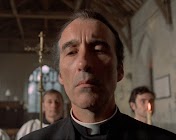
Christopher Lee.
Three great actors. One awful film.

Don't let anyone tell you that it's so bad that it's good. It isn't. It's just bad.

Order from Amazon.com
Order from Amazon.co.uk
Order from Amazon.de

Thursday, 11 April 2019

Night Train To Lisbon (3 Stars)


This is a slow moving political thriller based on a best selling novel with the same name.

Dr. Raimund Gregorius is a Latin teacher in the Swiss city Berne. He lives a boring life. That's what his ex-wife tells him, and he believes it himself. One day, on the way to school, he sees a young woman about to throw herself off a bridge. He pulls her back from the edge, but he's still worried about her. He takes her into his classroom and tells her to sit at an empty desk, despite the giggling of the children. After a few minutes she walks out, leaving her coat behind.

He runs out of the classroom, but he's too late to see where she's gone. The only clue is a book in her coat pocket, the memoirs of Amadeu de Prado, a man who trained to be a priest but then became a doctor. The words of the book hold deep philosophical messages which make him consider the meaning of his own life. Between the pages of the book he finds a train ticket to Lisbon. He goes to the station, hoping to see her getting on the train, but she isn't there. At the last moment he decides to get on the train and use the ticket himself. A spontaneous decision by a man who's never been spontaneous in his life.

In Lisbon he decides to track down the author. He soon finds out that he died 30 years ago, but that doesn't stop his interest in him. He speaks to his friends and his relatives, and he finds out that he was a member of the resistance during the Salazar dictatorship in the late 1960's. He discovers a series of intrigues and deceptions in the resistance that the surviving members are unwilling to talk about.


Even though the story is enthralling, I have to question its realism. Would any man, spontaneous or not, give up his job to search for the author of a book that belongs to someone he's just met? There doesn't seem to be any logic in what he did. Still, there are fine performances by Jeremy Irons as Dr. Gregorius and Martina Gedeck as the optometrist who assists him in his search. Bruno Ganz plays a small role as a former resistance member, and Christopher Lee is the priest who educated Amadeu in his Catholic school.


The film is almost a love story. Almost. Dr. Gregorius feels attracted to the beautiful optometrist who replaces his broken glasses, but he's not spontaneous enough to fall in love in a foreign country. Giving up his job in the middle of a lesson has exhausted his supply of spontaneity for years to come. He ought to let himself go. Nothing is as important as love.

Order from Amazon.com
Order from Amazon.co.uk
Order from Amazon.de

Thursday, 1 November 2018

The Wicker Man [1973 version] (4½ Stars)


Today I'm finally keeping a promise that I made two years ago. I promised to watch the two versions of the Wicker Man back to back. I watched the 1973 film today and I'll watch the 2006 film tomorrow.

I seem to be one of the few people who actually likes the 2006 version. Some people call it a remake, but that's incorrect. A film is a remake if it's a copy or adaptation of a previously made film. If two films are both based on the same book, the second film can't be called a remake. They're just different versions of the same story. Both Wicker Man films are based on the novel "Ritual" by David Pinner.

Putting it a different way, if a film has an original screenplay all future films that tell the same story are remakes. If a film has an adapted screenplay all future films that tell the same story are new versions. For instance:

"City of Angels" (1998) is a remake of "Wings of Desire" (1987).

"Dracula" (1958) isn't a remake of "Nosferatu" (1922), it's a new version.


Christopher Lee made more than 250 films in his lifetime. He's best known for playing Count Dracula in various films. Younger people might know him better as Saruman in the Lord of the Rings Trilogy. However, he claimed at the end of his life that "Wicker Man" was his best film. I don't know what criteria he used for this judgement. Maybe he only meant that it's the film he most enjoyed making. Whatever the reason was, he appreciated it more than all his other more famous roles.


Although Edward Woodward appeared in many films he's best known for his television roles. Some people like him best in the title role of "Callan", others prefer him as Robert McCall in "The Equalizer". When he was asked to play the spy boss Mr. Jones in "La Femme Nikita", his character was based on David Callan from the TV series.

In the film Edward plays Neil Howie, a sergeant in the Highland Police Force. It's not stated where he comes from (at least not in the film, maybe in the book), but I assume that as a senior officer he would have been based in Inverness. He travels to Summerisle, a fictional island in the Outer Hebrides, after receiving a letter asking him to find a missing girl.

The islanders are very uncooperative. First they claim they don't know the girl. When Sgt. Howie finds proof of her existence, they say that she's dead. He visits the cemetery, and her coffin is empty apart from a rabbit. His investigations go round in circles.

For Sgt. Howie it's not just about solving the case. He's a deeply religious Christian, and he's horrified by the paganism and sexual immorality that he sees on the island. He's engaged to be married, and he's still a virgin because he considers sex before marriage to be a sin. The sexual temptations are great.


He manages to resist Britt Ekland, the innkeeper's daughter, even though the sweat is pouring off his face.


He even manages to resist Ingrid Pitt, the librarian. I couldn't have resisted her. No way!


Even the village schoolgirls are over-sexualised. When he visits the school they're being taught about phallus symbols. He gets nervous and yells that it's disgusting.


At the centre of everything is Christopher Lee as Lord Summerisle. He's polite and well spoken, and he promises full cooperation in the investigations, but his answers are always evasive, as far as the inquiries into the missing girl are concerned. When it comes to the matter of religion he's more open and speaks at length. He defends the paganism practised on the island. It all makes more sense than the religion that Sgt. Howie follows. The islanders bring yearly sacrifices to the Gods, and in return they have a good harvest.


When it was released in the cinemas "The Wicker Man" was a commercial failure. Not even the big names in the cast could tempt people into the cinemas. Maybe the posters were confusing and people didn't know what to expect. Whatever the reason, it failed. In later years it acquired a cult following and now has ardent admirers.

Success Rate:  - 11.1

Order from Amazon.com
Order from Amazon.co.uk
Order from Amazon.de