Showing posts with label Kate Winslet. Show all posts

Sunday, 31 December 2023

Eternal Sunshine of the Spotless Mind (5 Stars)


This is my last film of the year. It's one of the best films I know, in third place in my top 100 films list. I had another film in my list planned, but I changed my mind after hearing about the death of Tom Wilkinson yesterday. The cause of his death hasn't yet been named, but his family says that it was unexpected. A heart attack? Maybe.

The eulogies are already pouring in. They name his memorable films, usually starting with "The Full Monty". Most of them don't even mention "Eternal Sunshine of the Spotless Mind". That's unfortunate, since it's his best film, but it's understandable, because he didn't play the main role. Or is it understandable? He only had a supporting role in "The Full Monty" as well.

I've written about "Eternal Sunshine of the Spotless Mind" seven times, but I haven't included photos of him in any of the reviews. I'll make up for it now. It's a twisted love film between Joel Barish (Jim Carrie) and Clementine Kruczynski (Kate Winslet), but there's also a love story between Howard Mierzwiak (Tom Wilkinson) and Mary Svevo (Kirsten Dunst), most of it off screen.


Dr. Howard Mierzwiak has invented a machine that can selectively erase memories. He uses it to help people forget loved ones. He's had an affair with Mary that almost wrecked his marriage, so he used the machine to make her forget their affair. The procedure works, even though Mary still works in his practice as his assistant. What he didn't consider is that if she forgets that she was attracted to him she might fall in love with him a second time.


Is a one-way memory erasure enough? When she adoringly looks at him, how can he not be reminded of the hours of passion he shared in her arms?

It's a wonderful film, one of the best films I've ever watched. The trouble is that it's a complicated film. I remember seeing it the first time in the cinema in 2004. It took me about half an hour to understand what was happening, and it wasn't until I watched it again on DVD that I began to understand the subtleties. It's two stories being told at the same time, one in the correct order, the other in reverse chronology. These two stories interact with one another, making the film even more complicated. I could tell by my son Benjamin's reactions that he didn't understand the film. I'll have to watch it with him again.

Tom Wilkinson
5 February 1948 – 30 December 2023

Farewell to a grand actor. He's sadly missed. I'll have to watch some more of his films next week. Maybe even "The Full Monty".

Success Rate:  + 1.6

Order from Amazon.com
Order from Amazon.co.uk
Order from Amazon.de

Thursday, 17 November 2022

Eternal Sunshine of the Spotless Mind (5 Stars)


It's Thursday again? I asked that question when I watched my last film, but the answer is different this time. It really is Thursday. What a coincidence!

This is one of my favourite films, third in my top 100 list. I've watched and reviewed it a few times. In the past I've concentrated on the film's philosophical aspects. Today I'll apply it to myself.

In 2002 I married someone, a beautiful young woman called Nicola. It was my second marriage, and I expected things to be better the second time round. I was wrong. It was Hell. We had one year of happiness and three years of suffering. It was all about drugs. A year after the marriage one of Nicola's friends stayed with us for a few days. Her boyfriend, Alexis Thomas, was a drug dealer. He said that Nicola should try crack, just once, to see what it's like. When it comes to drugs there's no such thing as "just once". She was hooked immediately.

At first she enjoyed smoking crack. After a while she realised it was harmful to her, and she wanted to stop, but she couldn't. I felt it was my duty to help her, but I couldn't. Her setbacks became my setbacks. In late 2006 there was a turning point. One evening she rang Alexis to tell him she wanted to buy crack from him. I locked the doors, took away her key, and I said I wouldn't let him in. She threatened to call the police and tell them I'd hit her. I thought she was bluffing, but she really did it. When the police came she was lying on the floor in the living room, saying she was too injured to get up after I'd been beating her.

The police arrested me. I was put in a cell briefly, but then they let me out and said that it was obvious from the start that I hadn't hit her. There were no bruises, and the telephone cable (landline) was too short for her to reach from her position lying on the floor. They'd only arrested me to keep the peace. The police station was too far away from my home, so I had to stay until morning. I sat playing chess with a police officer all night. When I got home Alexis had already left, but she was high on crack.

That incident scared me. If it happened again, the police might believe her next time. I didn't want a criminal record, so I gave up trying to help her and planned to leave her as soon as possible.


That brings me to the film. Would I want to forget Nicola? Would I want to erase her from my memory? (I'm assuming that my readers have seen the film and know what I'm talking about). My answer is a clear No. We had some beautiful times together, times which I never want to forget. Admittedly, the good times were few, but I'd like to hold on to them.

What about the bad times? There were many, many bad incidents in our marriage. The one I named above wasn't even the worst, even though it was the one that persuaded me to leave her. Some of my friends know more details, and they're shocked. Nicola made me suffer terribly, and I consider marrying her to be the worst mistake of my life. But do I want to forget what happened? In a way I do. They were things that no man should have to experience. On the other hand, remembering these experiences protects me from similar mistakes in the future. If I'd erased Nicola from my memory, I might have met her again a year later and got into a relationship with her again. Or maybe not. As far as I know, she's never overcome her addiction to crack. I would never have fallen in love with a drug addict. But I still like to remember the bad times as a warning. I try not to think about them. I push the memories into the back of my mind, but they're still there if I need to remember.

In 2012 my friend Brian Farmer was murdered. Four suspects were arrested, three men and a woman, but they weren't named until the trial began. One of my friends said to me, "I think the woman is Nicola". As it turned out, it wasn't her, but it shows how bad her reputation was.

In the film Mary Svevo (Kirsten Dunst) begins as a strong supporter of the memory erasure technique, and she ends up rejecting it. She was right to change her mind.

Saturday, 11 September 2021

Eternal Sunshine of the Spotless Mind (5 Stars)


Today is the 11th of September. The day is most commonly known as 9/11, based on the (illogical) American order of Month-Day-Year. Most people are talking about the event that took place 20 years ago today. I acknowledge it, but I prefer not to dwell on bad things in the past. I want to concentrate on positive things, such as films. I posted something about the 9/11 attack on the 10th anniversary, but I deleted the post a few months later because I was getting abusive anonymous comments. It's one of the few blog posts that I've ever deleted.


I don't know how well known this film is among my younger readers. It was a box office success when it was released in 2004, but nowadays it's rarely shown on television. That's a question I'd like to ask any of my readers under 30: have you seen this film? Leave your answer in the comments box.

The name is quite a mouthful, unusually long for a film title. The longest title in my personal collection is "The Incredibly Strange Creatures who stopped living and became Mixed-Up Zombies". In Germany the title has been shortened to "Don't forget me". I admit that the German title is more relevant to the film's content, but the screenwriter Charlie Kaufman wanted a long title. It's claimed that his first title suggestion was 18 words long, but I haven't been able to verify this. The final title is a quote from Alexander Pope's poem "Eloisa to Abelard", spoken by Kirsten Dunst as Mary Svevo in the film:

How happy is the blameless vestal's lot!
The world forgetting, by the world forgot.
Eternal sunshine of the spotless mind!
Each prayer accepted, and each wish resigned.

I prefer her other quote, by Friedrich Nietzsche, even though it contradicts the film's message:

Blessed are the forgetful, for they get the better even of their blunders.

At its core, "Eternal Sunshine of the Spotless Mind" is a love story, despite its underplayed science fiction background. If you've never seen the film before, you're in for a treat. The opening credits are delayed for almost 18 minutes. In the pre-credits sequence Joel Barish (Jim Carrey) spontaneously takes a day off work to spend a day on the beach in Montauk. It's Valentine's Day 2004. He's approached by Clementine Kruczynski (Kate Winslet), who blatantly forces herself on him. She talks to him in the train and doesn't even stop when he tells her he would rather be left alone. That evening she invites him home for a drink and leans against him romantically. She says that they should get married.

Stop!

If that happened to me I'd think that I'm dealing with a mentally deranged person. I'd run as fast as I can.

It's true that Clementine is eccentric, but she's far from deranged. The story unfolds after the credits.


The film is an emotional roller coaster. It's best known for its surreal special effects, but concentrate on the tragic young couple. All relationships have problems, some more than others. Walking away and forgetting your partner is the coward's way out. Love will find a way.


Clementine believes in love. It's written on her shirt. I've been unable to identify the shirt, because the text is hidden beneath her breasts. Some people claim it's "Love is a magic carpet ride", but the picture doesn't match that shirt.


Obviously. Does anyone have the right answer? Once more: use the comments box!

Success Rate:  + 1.6

Order from Amazon.com
Order from Amazon.co.uk
Order from Amazon.de

Wednesday, 27 January 2021

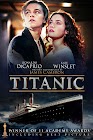
Titanic (5 Stars)


Today I thought Oliver would watch his second film. He picked "Madagascar 3" from Netflix. He sat fascinated for the first 72 minutes. Then there was a quiet scene. The characters were standing in the zoo talking to one another. That was too much for him. He turned the film off, even though I begged him to watch it till the end. It was only another 20 minutes. It was too much for him. He watched some silly little cartoon instead. It was called Trotro, something I've never seen before. Oh well. Maybe he'll find the patience to watch another film soon.

Soon he went to bed, so I turned to the next film in my top 100, "Titanic". It's a brilliant film. I don't know why I don't watch it more often. Maybe it's the length. I've noticed that I'm reluctant to watch films longer than three hours, however good they are.

There's no point in me describing the film. Everyone knows what happens. It's a love story set on a sinking ship. Here's my advice to single women: if you're thinking about marrying someone, watch "Titanic" with him. If he doesn't cry, he's no good for you. It makes me cry every time. Even Celine Dion's song, "My heart will go on", makes me cry, because it reminds me of the film.

The film is so well crafted, it can be used as an example of how to make a film. As far as the Academy Awards are concerned, it's the most successful film ever. It received 14 Oscar nominations, of which it won 11. Will that record ever be equalled, let alone broken? Time will tell.

I still think that this is Leonardo DiCaprio's best film. I know that sounds like an insult when said of a film early in someone's career, but I honestly don't think he's risen to this level since. Kate Winslet, on the other hand, has made many outstanding films since "Titanic".

Some of the films in my list will be a matter of taste, but how can anyone not like "Titanic"? Please let me know. If you don't like "Titanic", leave me a comment telling me why you don't like it.

While watching the film today I drank a glass of Eberbach-Schäfer's Schwarzriesling. I tried drinking it the correct way, as recommended by David Klenert. I poured it in a glass and waited half an hour before drinking it. It was amazing. After 20 minutes the room was full of the rich, fruity smell. I've even considered putting a small amount in a bowl in my bedroom at night. The wine definitely tasted better after being allowed to breathe. I wonder if all high quality red wines profit from this treatment.

Success Rate:  + 9.0

Order from Amazon.com
Order from Amazon.co.uk
Order from Amazon.de

Monday, 25 January 2021

Steve Jobs (5 Stars)


I chose to watch this film today deliberately. Last week it was on a short list of films that I was considering adding to my top 100 films list. I decided against it and only added "Kick-Ass". I realise now that I made a mistake. "Steve Jobs" is a film that should have been in the list, not at the bottom, but somewhere in the top 50.

I like Michael Fassbender as an actor. I've admired him ever since I first saw him as the fallen angel Azazeal in "Hex". His portrayal of Magneto in the X-Men films is stunning. I've never liked a bad guy so much. He steps up and gives a stunning performance as Steve Jobs in this film. There are probably other actors who look more similar to Steve Jobs in their facial appearance, but Fassbender captures his mannerisms and traits so perfectly that we can believe he really is Steve Jobs before our eyes.

The film is a play in three acts. We see Steve Jobs presenting new products in 1984, 1988 and 1998. We don't see anything of his childhood and very little of his early business years. That isn't the film's intention. It shows his relationship with his daughter and his business colleagues, especially John Sculley and Steve Wozniak. At the three presentations the same characters arrive to speak with him, most of it arguing. The film is well crafted in not demanding any technical knowledge from the viewers. My good friend Emma Roberts refused to see it in the cinema because she said she knew nothing about computers. That was a mistake. She would have enjoyed it as much as me.

As I've pointed out in my previous reviews, the whole film is spent in character development. In a normal film the character development comes first, and then the action. This is a film that doesn't need action. It's a talkie. From the very first scene Steve Jobs is involved in conversations with the people around him. The film is so intense in its lack of action that I had tears in my eyes at the end.

Success Rate:  - 0.9

Order from Amazon.com
Order from Amazon.co.uk
Order from Amazon.de

Friday, 1 March 2019

The Reader (4 Stars)


This is a film that I took down from my shelf this morning in remembrance of the late, great actor Bruno Ganz. It's a long time since I last watched the film, an unjustifiably long time. I didn't even remember that Bruno Ganz appeared in the film. I remembered that it starred Karoline Herfurth in a supporting role, but she's someone I could never forget.

The film begins in 1995 with the lawyer Michael Berg looking back on his life. In 1958 he was 15 and lived in Berlin. He fell in love with an older woman, Hanna Schmitz, a 36-year-old tram conductor. The affair only lasted for a few months, but it made an impression on him for the rest of his life. First love can do that. Every day he spent a few hours reading books to her, after which they made love. The sex was the most important thing to him, but the reading was more important to her. She laughed and cried at the stories he read her. Then she left Berlin suddenly without telling him where she was going. The relationship ended as abruptly as it had begun.

In 1966 Michael was studying law in Heidelberg. Bruno Ganz was his professor. Together with a small group of the best students they visited the trial of six women, Auschwitz prison guards, who were accused of letting 300 women die in a burning church. Michael was shocked to see that Hanna was one of the women. The other five women denied responsibility, but Hanna admitted and justified everything she had done, claiming the other women were equally guilty. In response they accused her of being the ringleader, telling them what to do and writing the report to their superiors about the action. Hanna denied having written the report, but when asked to give a handwriting sample she changed her testimony and agreed that she had written the report. Michael knew it wasn't true, because she couldn't read or write. She was ashamed of revealing to the world that she was illiterate. The other women received light sentences, but Hanna was sentenced to life imprisonment.


Some people might think of "The Reader" as a film about the Holocaust. That's not quite true. It's primarily a love story. The Holocaust is something that provides a background to the story. Hanna's complicity in the war crimes can't be denied, but she was a naive Mitläufer. Naive and uneducated. She worked as a guard, and she considered it her duty to do her job as best as she could. 20 years later her defence was that she was innocent because she was just following orders. As for the other five women, they were well aware of their guilt, but they lied to defend themselves. Hanna was at least honest in her testimony.


Karoline Herfurth plays Marthe, one of Michael's fellow law students.


I've always found her beautiful. She would have distracted me in the lectures.


Bruno Ganz admires her when they're sitting in court. I don't blame him in the least, but he should try to make it less obvious.


Bruno Ganz was an excellent actor in every role he played. There was something Shakespearean about him, if that's the correct word. Maybe a better word is regal. He had an imposing bearing in all his films, whether he was playing a university professor, a police chief or Adolf Hitler. His presence overwhelms the audience whenever he appears on screen. If you've seen any of his films you'll know what I mean.

"The Reader" was nominated for five Academy Awards, including Best Film. Kate Winslet won the award for Best Actress. She deserved it.

Success Ratio:  + 1.4

Order from Amazon.com
Order from Amazon.co.uk
Order from Amazon.de

Wednesday, 19 December 2018

Eternal Sunshine of the Spotless Mind (5 Stars)


First of all, I have to make an apology to my regular readers. I'm being visited by two of my children for the next three weeks, so I expect I shall have less time to write my blog. I'll be watching as many films as usual, because they'll be watching films with me, but I shan't have as much time for myself as I usually have. I'll still be writing about every film I watch, but my reviews will be shorter.

I don't have a full viewing schedule for the next three weeks, but I already know what I'll be watching for the next three days. While chatting with my son I found out that he hasn't yet seen my three favourite films, so I'll be watching them with him in reverse order. "Eternal Sunshine of the Spotless Mind" is my third favourite film.

It's a mind-bending science fiction story, but more than anything else it's a moving love story. It's a very untypical role for Jim Carrey. It's not his only serious film, but it's the film in which we see the least of his comic personality. The only comic relief in the film is supplied by Kate Winslet.


Does the film have a message? The message that I take from it is that it's better to remember than forget, but there any many other angles from which it can be watched. Maybe another message is that it's only possible to discover the value of what you have by starting again from the beginning.

The film only one one Academy Award, for the Best Original Screenplay. It should have won more.

Success Rate:  + 1.6

Order from Amazon.com
Order from Amazon.co.uk
Order from Amazon.de

Monday, 11 December 2017

The Mountain Between Us (3½ Stars)


Let's be honest. Any film that stars Idris Elba is worth seeing, whatever it's about. I prefer to see him as an action hero, but even in quieter roles he can express an emotional depth. He's one of the best actors in Britain today.

Two people meet at Boise Airport in Idaho on December 28th. Dr. Ben Bass (Idris Elba) is a brain surgeon, Alex Martin (Kate Winslet) is a journalist. They've both booked a flight to Denver. Ben has to perform an operation the next day, Alex is getting married. Because of heavy storms the flight has been cancelled. That's an emergency for both of them. They decide to split the cost of booking a small charter plane.

While flying over the mountains in Utah the pilot suffers a stroke and the plane crashes. The pilot is dead. Alex is badly injured. Ben is relatively unharmed, only suffering a few small bruises. Alex has to rest three days before she can walk. After that they begin to walk across the snowy mountains looking for civilisation, accompanied by the dead pilot's dog.


Prior to the release of the film there was some excitement about the dog, a Labrador who's only ever called Dog. The trailer gave the impression that the dog would die, which caused complaints in Internet forums. This prompted the studio to make a statement that the dog would not die. I'm not aware that a film studio has ever released an official spoiler like that before.

The film features exceptional performances by the two leading actors, underlined by breathtaking mountain scenes. The weaknesses are in the story itself. The epilogue, after the two return to civilisation, should have been short. Instead, it was painfully dragged out. The film could have come to a conclusion 15 minutes earlier.

Tuesday, 31 January 2017

Collateral Beauty (4½ Stars)


Here we go again. It's another one of those films. I mean the films that prove that the critics have lost touch with the public. This is a wonderful film, deeply moving in its romantic moments. It's a box office success. The public loves it. I love it. But the critics hate it. I shan't even bother trying to explain to you what they don't like about it. I'll just say that they're wrong.

The film is about Howard Inlet, the founder of a highly successful New York trading company. He has three business partners, but it's his genius and his charisma that carry the company. His life changes when his six year old daughter dies. His marriage breaks up. He becomes depressive and unable to work any more. After two years his partners lose their patience and want to have him declared mentally incapable of running the company. They find out that he's written letters to Love, Time and Death, complaining about what they've done to him. The partners hire three actors from a small theatre company to pretend to be these entities. They also hire a private detective to film him when he meets and argues with these three people, in the hope of making him seem unbalanced.

I shan't say anything else about the plot. You can already imagine that as soon as Howard is convinced that they're who they're pretending to be they have a profound effect on him. Unexpectedly, the three actors also connect with the three partners, helping them deal with their respective problems.

For years I've never liked Will Smith as an actor. That's beginning to change. He's no longer typecast as the brash kid from the ghetto. As he's getting older he's playing more serious roles, like this one. The film features several of my favourite actors, but Will Smith stands above them.

I repeat once more. This is a wonderful film, so don't let anything the critics say put you off watching it.

Order from Amazon.co.uk
Order from Amazon.de

Tuesday, 14 June 2016

Steve Jobs (5 Stars)


How can a film in which so little happens be so good?

That's the question I'm forced to ask after watching this film today for the second time. It's a talkie. The film is divided into three scenes, and in each scene Steve Jobs, played by Michael Fassbender, talks to his friends, his co-workers and his family. That's it. It must sound boring when described like that, and yet it isn't. It's a work of genius.

In a film of any quality time is spent developing the characters, after which the plot itself develops, involving action and drama. This film is different. The whole film is spent developing the characters. Everyone is described by his relationship to Steve Jobs. It's like he's the sun, and everyone else is a planet orbiting around him. Some planets are close and receive a lot of light. Others are more distant and are only partially illuminated. This is what makes the film so powerful. 

The director is Danny Boyle, famous for making "Trainspotting" and more recently "Slumdog Millionaire". It's been about 15 years since I saw "Trainspotting". As I remember, I didn't like it. The constant bad language put me off. Maybe if I watched it again I would appreciate it more. One day I will. "Slumdog Millionaire", on the other hand, is a film I deem important enough to list as one of the 30 films everyone should watch before he dies. Check my list on the right if you're reading my blog on a PC. I've tried to compare "Steve Jobs" to "Slumdog Millionaire", and I can't do it. The films are so drastically different that I can't see how Danny Boyle progressed from one to the other in the space of seven years. Between them he made two other films, "127 Hours" in 2010 and "Trance" in 2013, neither of which I've seen. Maybe if I watch them I'll be able to trace a line between the films.

Wednesday, 9 March 2016

Insurgent (3 Stars)


"Insurgent" is a sequel to "Divergent", beginning a few days after the end of the first film. The ruling Erudite faction has blamed the Dauntless faction for slaughtering the Abnegation faction, even though it was the Erudite leader, Janine, who orchestrated the attack. Tris and the rest of her Dauntless colleagues are on the run, sheltered first by the Amity faction, then by factionless rebels.

"Insurgent" has flashier special effects than "Divergent", but something is missing. The main characters aren't pleasant enough for us to sympathise with them. In the first film Tris (Shailene Woodley) at least looked pleasant, but in the second film she cuts her hair and looks boyish, no longer feminine.

As a sequel this is a disappointment. I dread to see what the third part will be like when I watch it at the weekend.

Monday, 7 March 2016

Divergent (4 Stars)


This is a rather typical modern story. A teenage girl has to rebel against the system around her. Most of the men and boys she meets are her enemies, but there's one that she falls in love with.

I find the story's premise rather weak. The idea that everyone has to fit into one of five accepted categories is unnatural. In society there are usually only two categories, the rulers and the ruled. Nevertheless, it's a heart-warming story about a young girl who doesn't fit in, even though she wants to.

Wednesday, 3 February 2016

Labor Day (4½ Stars)


This is a beautiful film, despite the word "Labour" being spelt wrong in the title. When I was in Berlin studying Linguistics we were told by a professor not to be snobbish with alternate national spellings; we should accept the variations as equally valid. For years I followed the professor's advice in my naive belief that the American variations were the result of gradual change over the centuries. It's only in the last few years that I discovered that this wasn't the case. The American changes didn't happen slowly, they were the invention of one man, Noah Webster, who decided how words should be spelt in America. He was an American patriot, and he wanted American spelling to be superior to British spelling.

After publishing pamphlets with spelling recommendations for years, Noah Webster finally published "A Compendious Dictionary of the English Dictionary" in 1828. Later editions were renamed the "Merriam-Webster Dictionary". This book has done more to sabotage the English language than any other document in history. It's a work of evil by a twisted old man.

Apologists claim that Webster didn't invent his alternate spellings himself. I disagree with this. It's true that some people wrote "center" and "color" before he wrote his dictionary, but these were mistakes made by people of lesser intellect. Noah Webster stood up and told the under-educated Americans they should continue to spell words the wrong way. His anti-British sentiments led him to do damage from which the English language has never recovered.

Thursday, 26 November 2015

Eternal Sunshine of the Spotless Mind (5 Stars)


30 films to watch before you die, #26

I need to write this down before I forget it.

This film was written by Charlie Kaufman. It was directed by Michel Gondry, but that's of lesser relevance. Films written by Charlie Kaufman have a distinctive style, whoever the director is. He enjoys a unique role in today's film culture. Most people who watch films can name the most popular actors. Serious film fans can name their favourite directors. But how many people can name screenwriters (not including the directors who write their own scripts)? I can only name one: Charlie Kaufman.


My memory is beginning to fade.

The film may have confused people when it was made. It stars Jim Carrey in the lead role, and at the time the film was released people still thought of him as a comedy actor, despite his serious roles in "The Truman Show" and "The Majestic". This led to the film being incorrectly labelled a comedy, even on the cover of the American DVD box. If anything, "Eternal Sunshine of the Spotless Mind" is the most serious role he has ever played. The only small hint of his humorous self is the way he gets stuck in train doors in the pre-opening credits sequence.


It's all getting so difficult to remember. Let me name another few films written by Charlie Kaufman before it's too late:

I'm sure there was something else I wanted to say. Let me check my notes, if I can remember where I put them.


I'm sorry, I can't remember what film I was writing about.

The Dressmaker (3 Stars)


This film is described on its Wikipedia page as an Australian spaghetti western revenge comedy-drama. Wow. It sounds like that was written by someone who had absolutely no idea what the film was about. Unfortunately the film itself doesn't seem to know what it's about.

The film opens with Tilly Dunnage, played by Kate Winslet, getting off the train in Dungatar, Australia, and saying "I'm back, bitches". This sets the stage for revenge, but we see very little revenge as the film progresses. Tilly was sent to Europe 20 years previously because she was accused of murdering a boy when she was 10. She claims to remember nothing about it, and she tries to find out from the townspeople what happened. She doesn't have revenge on her mind, she has investigation.

During her time in Europe she lived in London, Paris and Milan, and she was trained as a dressmaker in Paris. She earns money by making dresses for the women in Dungatar, but they still don't trust her.

The timeframe doesn't make sense to me. The film takes place in 1951, and she was 10 years old when she was sent to Europe in 1931. That means she was 18 when World War Two broke out. Was she already living in Paris in 1939, under German occupation? Even if she wasn't in Paris, she would still have suffered the effects of the war in London and Milan. It's strange that no mention of the war is made.

The film is an unusual quirky comedy. Maybe the book on which it's based makes sense. The film doesn't.

Saturday, 14 November 2015

Steve Jobs (4½ Stars)


This is a biographical film about the life of Steve Jobs, founder of "the other computer company". If I remember correctly, that's what Apple once called itself in an advertising campaign. In the early days of personal computers, from the late 1970's to the end of the 1980's, there were several companies that manufactured personal computers (more often called home computers), companies like Commodore, Atari and Texas Instruments, but the two most successful companies were IBM and Apple. Roughly speaking, IBM had a 60% market share, Apple 30%, and the other companies battled for the remaining 10%.

The film is effectively a play in three acts. All three acts take place in what looks like the same conference building – if it's not the same they're at least generically identical buildings – where Steve is presenting new products in 1984, 1988 and 1998. There are short flashbacks to previous events that occurred at other locations, but apart from that, everything happens on stage, in back rooms or on the roof of the building.

In 1984 Steve Jobs was presenting the Macintosh, in 1988 he was presenting the NeXT Cube, in 1998 he was presenting the iMac.

The strength of the film is that it doesn't just tell us about his successes and failures in his business life. It shows us the development of his relationship with his daughter Lisa, from the age of five (in 1984) to nineteen. At first he refuses to accept that she's his daughter, but even as time progresses we're given the impression that he rarely sees her. He didn't get on well with Lisa's mother because he thought she was only trying to get money from him.

In each act of the film the same people appear to talk to him, whether to encourage him or argue with him. There's his marketing executive Joanna Hoffman, his old friend and business partner Steve Wozniak, the corporate head of Apple John Sculley and a reporter from GQ. In their interaction with him we see that Steve Jobs was a difficult person to get on with. He had ideas in his head about what his computers should be like, but his ideas were based on aesthetics, not on commercial viability.


The film is a masterpiece from the hands of the British director Danny Boyle. The acting by Michael Fassbender (Steve Jobs) and Kate Winslet (Joanna Hoffman) is amazing. I didn't necessarily get to like Steve Jobs – that wasn't the film's intention – but I got to know him inside out, and well before the end of the film I cared about him and wanted him to find a solution for the problems in his life. This level of character development is something that all films should aspire to.

Monday, 19 May 2014

Eternal Sunshine of the Spotless Mind (5 Stars)


Over the last week I've watched a lot of disappointing films. Five films with 3 stars or less. I needed something good today to cheer me up. This is one of my favourite films ever.

If you want to know more about it, look for my other reviews in this blog. Or take my word for it and buy it. You won't regret it.

Thursday, 17 April 2014

Divergent (4 Stars)


The film takes place in Chicago "100 years after the war". As far as the people of Chicago know they are the last remainders of civilization, but they also fear that something exists outside the city, because they have built a protective wall around the city. Mankind has been divided into five factions, depending on their abilities and functions in society: the Erudite (the intellectuals), the Dauntless (the police force), the Amity (peaceful farmers), the Candor (philosophers who value truth above all else) and the Abnegation (charitable people who look after others). The Abnegation are the city's rulers. There are many who don't belong to a faction, but they are treated as outcasts, having to live on the streets and not allowed to work. They would starve, if not for the Abnegation giving them food.

When they turn 16 children have to decide which faction they want to belong to. They are given an aptitude test as a guideline, but they can choose any faction regardless of the test results. 95% of the children choose the faction of their parents. Any who choose a different faction have to leave home to live with their new faction. Beatrice and her brother Caleb are Abnegations, but she chooses to join Dauntless while he chooses to join Erudite. The film follows Beatrice's training to enter Dauntless. There are 30 new Dauntless members, but they are told that only 10 will be accepted; the 20 who perform worst during training will be expelled and become factionless.

People reading this must be asking themselves if everyone fits neatly into one of the five categories. That's just the point of the film. In the authoritarian structure of the future everyone is expected to exactly fit his role in society. Those who don't fit in are called "divergents" and are executed. In her aptitude test Beatrice is found to have the traits of three factions, Abnegation, Erudite and Dauntless, but the tester protects her by not making the result public.

The film is based on the first of a series of books for young people by Veronica Roth. It seems to be yet another candidate for a film series intended to be a successor to the Harry Potter films. It's quite adequate for this. It has more action and moves faster than "Mortal Instruments". Let's see how the sequels pan out.

Tuesday, 18 February 2014

Carnage (3½ Stars)


Cruelty and Splendour, Chaos and Balance

Two 11-year-old boys have a fight in the park. One hits the other with a branch and knocks out two of his teeth. The parents meet to discuss the incident. That's it.

This is a very minimalist film directed by Roman Polanski. Apart from a short introductory scene without dialogue, the whole film takes place in one scene with four people. Only good actors can pull off something like this, and the actors are all first rate: Christoph Waltz, Kate Winslet, Jodie Foster and John Reilly. All four do a tremendous job, but in my eyes Kate Winslet steals the show.

P.S. This is the first film I've seen in which Kate Winslet doesn't bare her breasts. Oh wait, there was "Eternal Sunshine of the Spotless Mind". But apart from that I can't think of any.

Saturday, 26 October 2013

Eternal Sunshine of the Spotless Mind (5 Stars)


Okay, after watching "I love you, Phillip Morris" yesterday I had to watch another film with Jim Carrey, and this was the best choice I could make. "Eternal Sunshine of the Spotless Mind" is one of the best films I've ever seen. It's definitely in my top five. The screenplay by Charlie Kaufman is mind-blowing.

Click here to read my last review. That includes the facts about the film, and I can't improve on what I wrote, as far as the facts are concerned. I'd just like to add something about the underlying philosophy. Forgetting the past is criticised in no uncertain terms. That's something everyone should take from the film. However painful a person's memories might be, it's better to remember them than to forget them. To quote the famous words of George Santayana, "Those who cannot remember the past are condemned to repeat it". We see this in the film in the case of Mary Svevo, but I won't say anything more about it here because it would be a spoiler.

Mary changes her attitude once she realises what she's forgotten. She begins by saying, "Blessed are the forgetful, for they get the better even of their blunders". This quote from Friedrich Nietzsche is so important to her that she says it twice during the film. My regular readers know that I have a low opinion of Nietzsche, so I'm glad that she rejected this philosophy by the end of the film.


Let me quote Nietzsche's "Midnight Song". I've added my own translation, which is more accurate than the official poetic translations:

O Mensch! Gib Acht!O man! Listen!
Was spricht die tiefe Mitternacht?What is the deep midnight saying?
"Ich schlief, ich schlief."I was asleep, I was asleep,
Aus tiefem Traum bin ich erwacht.     I awoke from a deep dream.
Die Welt ist tief,The world is deep,
Und tiefer als der Tag gedacht.Deeper than day could know.
Tief ist ihr Weh —The world's woe is deep,
Lust — tiefer noch als Herzeleid.And the world's longing is deeper than heartache.
Weh spricht: Vergeh!Woe tells it to cease,
Doch alle Lust will Ewigkeit,But all longing wants eternity,
Will tiefe, tiefe Ewigkeit!"Deep, deep eternity."

Night knows secrets that day doesn't. We can conclude that night keeps the secrets from day, jealously concealing the knowledge gleamed from dreams. The night is the messenger of forgetfulness. The world is torn between two extremes: longing for the future and heartache for the past. Nietzsche sees woe as a negative element that tries to hold back longing. Woe is the ally of heartache and wants to preserve it. Woe wants to keep the world centred on the past, but longing strives forward to eternity. This might not seem bad in itself, but we see the consequences in the context of Nietzsche's other writings. By striving towards the future we abandon the past completely. This means that in the quest to become the Übermensch, the Superman, the weak ones of the past are trampled underfoot.

That's a very brief explanation of the poem, I know. Philosophy students have written whole theses about this poem, not always agreeing with one another in their expositions.

A balance is needed between the past and the future. As a certain eccentric film fan once said:

"Live in the present, fight for the future, remember the past".