Showing posts with label Anna Friel. Show all posts

Monday, 7 February 2022

The Look of Love (4 Stars)


Name: Paul Raymond
Lived: 15 November 1925 – 2 March 2008
Film dates: 1956 to 1992
Film made in 2013

I'm biased against Paul Raymond. When I hear his name I always think of him as the man who ruined Mayfair. I mean the men's magazine called Mayfair, not the area in London. Mayfair was the only men's magazine I ever bought. Let me backtrack:

When I lived with my parents my father used to buy men's magazines: Penthouse, Playboy, Men Only, Club, Razzle and Mayfair. He hid them in a box on top of his wardrobe, but I soon found the hiding place and occasionally took a peek. Maybe he didn't buy them; maybe he just borrowed them or swapped them with his friends at work. Probably the latter, because the selection of magazines frequently changed. The old magazines disappeared and new ones arrived in their place. I never asked him. I was about 12 when I started looking at his magazines, and I continued until I was 22.

I divide the magazines into three classes:

1. Playboy and Penthouse were smooth and glamorous. Too American. Not sexy enough.

2. Men Only, Club and Razzle were overtly sexual. Too rough and pornographic.

3. Mayfair was glamorous and discreetly sexual. Perfect for my tastes.

The magazines in the second group were all published by Paul Raymond. I didn't like his style. After I left home at the age of 22 I regularly bought Mayfair. It was the only men's magazine I was interested in. Then, in 1990, Paul Raymond bought Mayfair. Within two months it became a clone of his other magazines. I stopped buying Mayfair. Since then I've never found a magazine to replace it.


Originally, Paul Raymond was known for his musicals and plays that featured nudity. It began very slowly in 1956, but as the laws were relaxed the nudity became more and more explicit. He always insisted that the nudity was tasteful. Based on the evidence of the film, I agree. The problem is that he was ahead of his time. Prudish Britain needed to catch up with him.

The magazines, starting with Men Only in 1971, were more explicit from the start. Paul Raymond also claimed they were tasteful, but I disagree. For me there's nothing tasteful about a naked woman spreading her legs for the camera. That's not what I like.

Those two businesses, the shows and the magazines, are what the public at large knew about him, but he had a third line of business that made him rich. In the late 1950's he began to buy houses in Soho. They were poor quality and cheap, but he predicted their value would rise. He was right. By 1992 his property was valued at £1.5 billion, making him the richest man in Britain.


The film concentrates on Paul Raymond's theatre shows and his magazines. The property business is only mentioned in passing, when he points out to his granddaughter all the houses he owns. We see that he's an immoral man who was unable to remain faithful to any one women. The person he loved most in the world was his daughter Debbie. Was he a good father? In my opinion, No. When he found out that she was taking drugs, in particular cocaine, he made no attempt to stop her. The most disgusting scene in the film is when he gives Debbie cocaine in hospital while she's in labour. It made the birth easier to handle. But at what cost?


Debbie Raymond died of a drug overdose in 1992, at the age of 36, leaving two small children behind. That's where the film ends. That's effectively where Paul Raymond's life ended. He spent the last 16 years of his life in his penthouse suite with the blinds drawn. He was the sad billionaire. Hardly anyone was ever allowed in to see him.

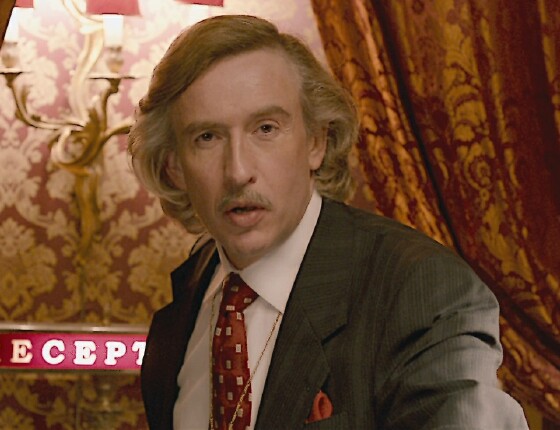
Steve Coogan expertly plays Paul Raymond in a way to make the viewer feel sympathetic with him. But to me he'll always be the man who ruined Mayfair.

Order from Amazon.com
Order from Amazon.co.uk
Order from Amazon.de

Tuesday, 10 December 2019

The Look of Love (4 Stars)


Doesn't a girl wrapped in a Union Jack make you feel proud to be British? We Brits aren't as obsessed with our flag as the Americans or the Swiss, we usually only dust off our flags for sporting occasions, but this photo should make our hearts beat faster. It's Tasmin Egerton, who plays the role of Fiona Richmond in the true story about the life of the sad billionaire Paul Raymond. I assume that the screenshot above is based on a real photo session in the 1970's, when she was at the peak of her fame.


Was Paul Raymond really sad? He was the richest man in England, and he had sex with countless beautiful women, so most men would envy him. The film shows that money can't make you happy, and sex definitely can't make you happy. At the beginning of the film we see that he has a loving wife who knows that he's being unfaithful with a series of one-night stands. Each night when he returns home late she asks "Was she nice?" He makes no attempt to conceal his infidelity. She loves him enough to put up with his minor affairs. It isn't until he meets Fiona Richmond and stops coming come that she wants a divorce.

Paul Raymond never officially married Fiona, but they had a steady relationship that lasted for a few years (between six and ten years, I can't be sure). She was a sexual woman, and she liked doing threesomes or foursomes with Paul, but she became jealous when he started doing threesomes or foursomes without her. She was willing to share him with other women, but she refused to give him away, not even temporarily.


Fiona Richmond's name was well known when I was growing up. To advertise one of her plays she rode naked on a white horse through the narrow streets of Soho. She was arrested, despite claims that she was portraying Lady Godiva, an icon of British culture. She had to pay a fine, but it was worth it. The tickets of her play sold out. It was a deliberate attempt to shock people, staged by Paul Raymond. He was famous for pushing boundaries. He knew exactly what was allowed in the prude British culture of the 1960's and 1970's, and he always did just a little bit more.

Fiona was also well known for her series of reports, "Around the World in 80 Lays", published in the men's magazine Mayfair. It was a comparison of her experiences with men from different countries, in particular how good they were in bed. As a teenager I read the reports. Mayfair was easily accessible to me, either my father's copies at home or the magazines secretly passed around at school. I was slightly disappointed to find out in the film that it was all fictional. Fiona never left her luxury London apartment, she just sat at her typewriter inventing her stories about men from Moscow to Sydney. I wanted to believe the stories, but Fiona was faithful to Paul Raymond. He didn't deserve her.


In London Paul Raymond was best known for his theatres and cabarets that pushed the boundaries of good taste, at least in the 1970's. Naked women dancing with snakes was scandalous 45 years ago, but today we just find it amusing. In the rest of England he was better known as a publisher of men's magazines. Starting with Men Only, he later founded the magazines Razzle, Club and Fiesta. The magazines all featured his name on the cover beneath the logo, so we knew they were his magazines. It was obvious anyway. They were virtually clones of one another, all with semi-pornographic images. For a few years Men Only was the best selling men's magazine in Britain, outselling the foreign magazines Penthouse and Playboy. This changed when Mayfair was founded in 1966. Paul Raymond's magazines were based on the style of European hardcore magazines, even if they didn't go as far, but Mayfair was a very British magazine. It was a men's magazine version of the Page 3 feature, in style and essence. Even if the girls were completely naked, they still looked glamorous.

It was a thorn in Paul Raymond's eye that Mayfair was outselling him. In 1990 he finally managed to buy Mayfair. At that time I regularly bought Mayfair, and I remember how my heart sank when his name first appeared on the cover. The transition was fast. The first magazine was still in the old style, but from the second issue onwards it sank to the same level as all his other publications. He destroyed Mayfair.

Theatres and men's magazines made Paul Raymond famous, but they're not what made him wealthy. He invested in Soho, buying property when houses were cheap. This part of his career is only mentioned in passing, and the film makes no attempt to show us how he became a property investor. This was his true genius. The houses were worthless, in a seedy part of London where nobody wanted to live, but he knew that prices would rise. The increase in property values is what made him the richest man in England. His wealth didn't make him happy. He was named the richest man in England in December 1992, one month after his daughter Debbie died of a drug overdose. He never recovered from her death. He spent the last 16 years of his life in his apartment with the curtains drawn shut, apart from occasional contact with his grandchildren, Debbie's daughters. Maybe he could have been happy if things had happened otherwise, but without Debbie he was a sad billionaire.

Order from Amazon.com
Order from Amazon.co.uk
Order from Amazon.de

Saturday, 20 October 2018

Bathory (4 Stars)


This is the fourth film that I've watched this month about Countess Elizabeth Bathory of Hungary. It tells a different story to the other films, even though it shows several of the same supporting characters. The director Juraj Jakubisko is Slovakian, and the place where Elizabeth Bathory lived is now part of Slovakia. His goal is obviously to put the Countess in a good light. Whereas the film "The Countess" suggested that she might not have done all the crimes attributed to her, this film states openly that she never bathed in blood.


This text from the end of the film shows a very one-sided version of the story. That's acceptable in itself. When telling true stories the writer and director have to interpret the past, especially if there are questions about the historical records. However, in order to discredit the "unsubstantiated accusations" of Gyorgi Thurzo the director invents stories of his own. For instance, Gyorgi captures peasant girls and puts them in Elizabeth's dungeon as proof that she is killing virgins. There are no records or even rumours of this being the case. The monks Peter and Cyril, both purely fictional characters, examine Elizabeth's bath water and discover that it's water mixed with red herbs, not blood at all. "Bathory" can't be taken seriously as a historical record.


That doesn't mean that Elizabeth Bathory is portrayed as a saint. She whips the servants who displease her, and she stabs a maid to death who makes a mistake while cutting her hair. That wasn't illegal under Hungarian law. As Countess she was allowed to kill her servants, and she was certainly allowed to whip as many men as she liked. What wasn't allowed was witchcraft, which included bathing in blood. That's why it was essential for Gyorgi Thurzo to prove this crime.

Ironically, in the film Elizabeth, a Protestant, was denounced as a witch by the Protestant pastor, while the Catholic monks spoke out in her defence. But as I already said, the monks were fictional characters, invented for the film. I wonder if the director is a Catholic who wanted to defend his religion.


Franco Nero appears as King Mathias II of Hungary. It's just one scene, but I was thrilled to see him. This is the only time I've seen him when he wasn't playing Django.

I can overlook the untruthfulness of this true story. What I don't like is the poor acting. The main characters, including Anna Friel, Karel Roden and Franco Nero, are all excellent actors. The problem is the supporting characters. They speak their lines flatly without emotion. Maybe they aren't bad actors, but that's how they appear from the way they speak. All of the minor actors and actresses are Slovakian, and they have to speak English. It's understandable that they sound mechanical when speaking in a foreign language.

The film was a flop. Understandably. Who's interested in Elizabeth Bathory outside of Hungary and Slovakia? It was a brave step for Juraj Jakubisko to make the film in English, but that wasn't enough to drag foreign viewers into the cinema.

I've decided to add a "success rate" to my film reviews, positive if it made a profit, negative if it made a loss, zero if it broke even. This is only an estimation, but it should give a picture of a film's success at the box office. I'd factor in DVD and Blu-ray sales, but they aren't public.

Success Rate:  - 3.4

Order from Amazon.com
Order from Amazon.co.uk
Order from Amazon.de

Thursday, 18 January 2018

The Look of Love (4 Stars)


Money can't buy love. But if you have enough money you can maintain the appearance of love for a long time.

When billionaire Paul Raymond died in 2008 he left his son Derry McCarthy nothing. Not one penny. I don't know where he lives now. He's faded into obscurity. It wouldn't surprise me if he's happier than his father ever was.

Click here for a more detailed review.

Order from Amazon.com
Order from Amazon.co.uk
Order from Amazon.de

Wednesday, 6 November 2013

The Look of Love (4 Stars)


This is the true story of Paul Raymond, the man who arrived in London with five shillings (less than a dollar) in his pocket and died a billionaire. Rather than concentrating on his path to riches the film follows his relationship with the woman he loved most in the world, his daughter Debbie.

Paul Raymond was born as Geoffrey Quinn in 1925. He avoided serving in the second world war by pretending to have a heart condition. He made his first money selling goods on the black market. After the war he worked in a fairground as a mind reader. His first step on the road to riches was in 1951 when he opened England's first strip club. With the money he made he had the foresight to invest in property, buying hundreds of buildings in London's Soho area at a time when they were cheap. However, his main interest was in presenting naked women to the public. The first women he showed weren't allowed to move on stage, but as laws became more liberal they could dance and even simulate erotic acts. He insisted that he wasn't selling pornography, it was all about art, but he was often fined for indecency. He didn't care about the fines, because every court case brought him publicity and more customers.

From strip clubs he branched out into theatres and music halls, but everything he did featured nudity, whether it was full nudity or just bare breasts. In 1971 he bought the men's magazine "Men Only", which soon became England's best selling men's magazine, selling more copies in England than any other English magazine, also outselling imported magazines like "Playboy" and "Penthouse". When "Men Only" fell to third place in the late 1980's he reacted by buying his competitors' companies, giving himself a monopoly.

In his personal life Paul Raymond was amoral. He was married twice, followed by a long relationship to the columnist Fiona Richmond, but he was never faithful to any of the women in his life. This alienated his son Howard, but his daughter Debbie stuck with him whatever happened. At first it might have been teenage rebellion; after the divorce from his second wife Debbie remained with her mother, but finding her too strict she went to live with her father. This was Debbie's downfall. Paul doubtlessly loved his daughter, but he should have been stricter with her. He never criticised her for using cocaine. A good father would have done everything to make her stop.

Debbie wanted to have a career as an actress and singer. Her father did everything he could to support her, giving her the lead role in his performances. Everyone around her knew that she had no talent. Everyone except for her father. This is excusable. I would have done the same in his position, as far as putting her on stage was concerned. I wouldn't have let her use drugs. She died of a heroine overdose in 1992. Did Paul recognise his guilt? I don't know. What I do know is that after her death he became a recluse, rarely leaving his penthouse. All the joy had gone from his life.

The film is simple but overpowering, framed by scenes of Paul as an old man alone in his room watching family videos. Maybe the film should have told more. The story starts in 1958, when he was already a wealthy man. I would have liked to see his early struggles. In the first half of the film Paul is portrayed as a superficial pleasure seeker, and it's difficult to like him. While watching the second half, as the relationship with his now adult daughter deepened, I had tears in my eyes. There's nothing more beautiful than the relationship between father and daughter.