Showing posts with label Laurence Fishburne. Show all posts

Wednesday, 29 April 2026

John Wick 4 (5 Stars)


"John Wick Chapter 4" feels like the moment the series finally confronts the weight of its own mythology; not by expanding it further, but by testing whether it can be broken.

Across "John Wick" and "John Wick Chapter 2", the assassin world evolved from suggestion into structure; by "John Wick Chapter 3", it had hardened into something close to dogma, enforced by the High Table with near-religious authority. "Chapter 4" takes the next logical step; it treats that system not as an unchangeable fact, but as a construct that can be challenged, manipulated and, ultimately, outplayed.

What's striking is how the film reframes the mythology through ritual. The duel that forms the climax is not just a plot device; it's an ancient mechanism embedded within the rules of the High Table itself. After three films of escalation, the idea that everything can be resolved through something so formal, so archaic, almost feels like a loophole in the system. The mythology turns inward, revealing that its rigidity contains the seeds of its own undoing.

This is where John Wick changes most significantly. In earlier films, he was defined by his relationship to the rules; first as a legend outside them, then as a man bound by them, and finally as someone hunted by them. Here, he becomes a strategist within the mythology. He doesn't just fight the system; he learns how to use its language against itself. The coins, the markers, the codes of conduct; these are no longer constraints, but tools.

At the same time, "Chapter 4" subtly demystifies the High Table without ever fully exposing it. Its representatives, particularly the Marquis, suggest that power within this world is not purely ancient or divine, but also political, contingent and, crucially, vulnerable to ego. The mythology shifts from something monolithic to something inhabited by individuals who can make mistakes. That shift matters; it brings the series back from abstraction towards something human, even as it maintains its operatic scale.

Yet the film resists the temptation to over-explain. After the relative over-articulation of "John Wick Chapter 3", this instalment pares back exposition and lets ritual, geography and action carry the meaning. The journey through Osaka, Berlin and Paris suggests a world that is vast but coherent, bound by shared customs rather than explicit rules. The mythology regains some of its mystery, not by shrinking, but by becoming less verbal.


The question of whether John Wick can still be alive sits at the centre of this approach. On a literal level, the film presents his death with a degree of finality; the wounds, the exhaustion, the quiet acceptance. But the staging is deliberately ambiguous. We see a grave, but no body; we hear eulogies, but no confirmation. In a series so concerned with codes and appearances, that absence feels intentional.

More importantly, the mythology itself provides a possible answer. This is a world where identity is fluid, where names carry weight and can be shed or reclaimed. John Wick has already died once, retreating into legend before being drawn back. Within a system that runs on ritual and perception, death does not have to be purely physical; it can be symbolic, a way of exiting the game.

There is also the practical dimension. The High Table operates on recognition and enforcement; if it believes Wick is dead, its pursuit ends. In that sense, death becomes a strategic disappearance, a final exploitation of the rules he has spent four films learning to navigate. The mythology allows for that possibility because it values order over truth; what matters is not whether Wick lives, but whether the system believes he does not.

Still, the film walks a careful line. To insist too strongly on his survival would undercut the thematic resolution; Wick's arc has always been about escape, and death is the only absolute escape the series can offer without contradiction. By leaving the question open, "Chapter 4" preserves both possibilities; the man may be gone, but the legend, as always, endures.

In the end, "John Wick Chapter 4" doesn't just conclude the mythology; it reflects on it. What began as a whisper of a hidden world has become a fully realised system, then a prison, and finally something that can be transcended. Whether John Wick is alive or dead almost becomes secondary. The real question is whether he has finally stepped outside the mythology that defined him; and for the first time, the answer might be Yes.

Success Rate:  + 2.4

Order from Amazon.com
Order from Amazon.co.uk
Order from Amazon.de

Wednesday, 8 April 2026

John Wick 3 (5 Stars)


"John Wick: Chapter 3 – Parabellum" pushes the mythology of the series to its most overtly operatic extreme; where "John Wick" hinted at a hidden order and "John Wick: Chapter 2" mapped its structure, the third film tests its limits, asking what happens when a man openly defies it.

The key shift in "Parabellum" is that the mythology is no longer background texture; it becomes the narrative engine itself. The concept of excommunicado, introduced at the end of the previous film, transforms the assassin world into something closer to a totalitarian system. Once John Wick is cast out, every rule, every ritual, every institution we have seen before turns against him. The coins, the markers, the sanctuaries; all are rendered useless. What was once a structured society becomes a mechanism of pursuit.

This escalation brings the governing body, the High Table, into sharper focus. In earlier films it functioned as an abstract authority; here it begins to take on form through emissaries like the Adjudicator. The shift is significant. The mythology moves from suggestion to embodiment, from whispered power to visible enforcement. Yet the High Table remains deliberately opaque; its members are never shown, preserving a sense of distance that keeps it from becoming mundane. It still feels less like a boardroom and more like a pantheon.

One of the film’s most striking developments is its expansion into the past. Wick’s journey to the desert and his encounter with the Elder reframes the mythology in quasi-religious terms. Authority is no longer merely institutional; it is spiritual, almost metaphysical. The idea that allegiance can be sworn through acts of physical sacrifice suggests a belief system rather than a legal framework. This pushes the series further away from crime fiction and closer to myth; the assassin world now resembles a faith with its own rites and absolutions.

At the same time, "Parabellum" complicates the idea of neutrality that was so central to the earlier films. The Continental, once an inviolable sanctuary, becomes a battleground when its manager refuses to bow fully to the High Table’s demands. This is a crucial development. The rules are no longer stable; they can be bent, reinterpreted or outright broken depending on who holds power. The mythology, which once felt rigid and ancient, begins to show cracks.

However, this expansion comes with a certain loss of elegance. In "John Wick: Chapter 2", the pleasure lay in discovering the system; here, the film risks over-articulation. The more the mythology is explained, the less it retains the enigmatic quality that made it compelling. Characters speak more openly about rules, hierarchies and consequences, and the sense of a hidden world gives way to something more explicit, almost bureaucratic in its complexity.

Yet the film compensates by using this very complexity to redefine John Wick himself. If the first film made him a legend and the second bound him to a system, the third positions him as a potential disruptor of that system. His survival is no longer just a matter of skill; it becomes an act of resistance. The mythology, once something that elevated him, now seeks to erase him; and in opposing it, he begins to take on a different kind of mythic status.

The final act underscores this transformation. Alliances shift, loyalties fracture and the supposedly immutable order reveals itself to be contingent. The world of assassins is no longer simply a closed circuit of rules; it is a contested space, where power can be challenged, if not easily overturned.

In the end, "John Wick: Chapter 3 – Parabellum" represents both the peak and the strain of the series’ myth-making. It expands the universe to its widest scope; geographically, philosophically and symbolically. But in doing so, it edges closer to demystification. The balance between suggestion and explanation begins to tilt.

Still, the achievement is undeniable. The trilogy evolves from a minimalist revenge tale into a fully realised mythos, one that blends ritual, violence and hierarchy into a coherent, if increasingly elaborate, world. "Parabellum" may reveal too much, but it also proves that the world of John Wick can sustain that revelation; and perhaps even survive its consequences.


The Continental hotel is an imposing building in the film. In real life the building used for external shots is the Beaver Building, on the corner of Beaver Street and Pearl Street, close to Wall Street. In actual fact there's a restaurant on the ground floor, and the upper floors are used for office space. It's 22 floors high, one of the smallest buildings in the vicinity. The buildings on either side are 37 and 42 floors high, respectively, while the buildings on Wall Street are 60 floors high or more.

Success Rate:  + 2.4

Order from Amazon.com
Order from Amazon.co.uk
Order from Amazon.de

Saturday, 4 April 2026

John Wick 2 (5 Stars)


"John Wick: Chapter 2" takes the sleek, stripped-down revenge framework of "John Wick" and expands it into something far more elaborate; not just a sequel, but a deepening of a strange, ritualised underworld that now feels almost mythic in scope.

In the first film, the mythology was tantalising but restrained. We glimpsed a hidden society of assassins governed by codes, currencies and neutral zones; The Continental stood out as a kind of sanctuary, its rules lending the violence a peculiar sense of order. John Wick himself was less a man than a whispered legend; "Baba Yaga" invoked in hushed tones, his past suggested rather than explained.

"Chapter 2" decisively pulls back the curtain. The sequel introduces the idea that this world is not merely a loose network, but a fully institutionalised hierarchy with global reach. The High Table – an unseen governing body – shifts the tone from crime thriller to something closer to dark fantasy; power is abstract, distant and absolute. This is no longer just about gangsters; it is about systems that feel ancient and unbreakable.

The expansion is most effective in its details. The gold coins, already present in the first film, are given greater texture as a kind of all-purpose currency that transcends national borders. Blood oaths, embodied in the "marker", introduce a feudal element; obligation is literal, sealed in blood and enforced with ritual gravity. These touches suggest a society bound less by law than by tradition, as though the assassins operate under a code older than modern civilisation.

Crucially, the film also widens the geographical scope. Rome becomes a stage for this underworld’s operations, with its own Continental branch and its own local customs. This decentralised yet unified structure reinforces the sense that John Wick’s world exists parallel to our own; invisible, but everywhere. The mythology grows not by exposition dumps, but by showing how the same rules manifest in different places.

Yet there is a trade-off. As the mythology expands, John Wick himself becomes slightly less mysterious. In the first film, his legend was defined by absence; here, the film risks over-defining him by embedding him more concretely within the system. His past is no longer just rumour; it becomes contractual, bureaucratic. The danger is that myth turns into lore, and lore into something almost procedural.

That said, the sequel cleverly uses this very expansion to trap its protagonist. By formalising the rules of the assassin world, Chapter 2 turns them into a mechanism of inevitability. Wick is no longer simply avenging a personal loss; he is ensnared in obligations he cannot escape. The climax, set within the mirrored halls of a modern art museum, feels like a visual metaphor for this shift; infinite reflections of a man who can no longer step outside the system that defines him.

In the end, "John Wick: Chapter 2" succeeds not just by raising the stakes, but by redefining them. The violence is still balletic and precise, but it now unfolds within a world that feels governed by mythic rules rather than mere narrative convenience. Where the first film hinted at a hidden order, the sequel reveals it; vast, intricate and ultimately inescapable.

It's a bold move. By expanding its mythology so aggressively, the film risks diluting the elegance of the original’s simplicity. Yet it also lays the foundation for a saga that can sustain itself beyond a single act of revenge. John Wick is no longer just a story; it is a world, and in "Chapter 2", that world finally takes shape.

Success Rate:  + 2.3

Order from Amazon.com
Order from Amazon.co.uk
Order from Amazon.de

Thursday, 28 March 2024

John Wick 4 (5 Stars)


I watched this film two days ago, but I didn't write much because I was getting ready to go away for a weekend holiday. I took the Blu-ray with me because I wanted to watch it again. Now I'm not writing much because I'm away from home and have even less time. It's a terrific film, probably the best in the series. I say probably because it's difficult for me to make up my mind. Visually, it's in a class of its own. New York, Morocco, Osaka, Paris, Berlin. The action switches from country to country like a James Bond film.

Donnie Yen plays Caine, a blind assassin who's an old friend of John Wick. He enjoyed making the film so much that he's asked to return, either in a sequel or a spin-off. No decision has been made yet. I hope he's given a chance.

Success Rate:  + 2.4

Order from Amazon.com
Order from Amazon.co.uk
Order from Amazon.de

Tuesday, 26 March 2024

John Wick 4 (5 Stars)


Farewell to Charon, as played by Lance Reddick. In "John Wick 4" he's executed in a senseless act by the Marquis de Gramont. A short while after making the film the actor himself died of a heart disease.

This is truly a wonderful film. I don't know why I only gave it a four star rating when I saw it in the cinema last year. The only thing negative is that I'm annoyed by Scott Adkins' bloated appearance. I barely recognise him. All I can say is that I'm glad he was killed, because it means I don't have to see him in a future sequel.

Or do I? John Wick was killed, but the fifth film in the series has already been announced. You can't keep a good man down.

Success Rate:  + 2.4

Order from Amazon.com
Order from Amazon.co.uk
Order from Amazon.de

Saturday, 23 March 2024

John Wick 3 (5 Stars)


In my opinion, "John Wick 3" is the best film in the series so far. The second film ended on a cliff-hanger. John was excommunicated for killing Santino D'Antonio in the Continental. "No business may be conducted on Continental grounds". That's one of the main rules in the shadowy parallel world of John Wick.


Rather than accepting his fate, John seeks an audience with the man who is above the High Table. He lives in the desert somewhere in Morocco. Couldn't a man with such wealth find a more comfortable place to live? John will be allowed back if he completes a task: he has to kill Winston, the manager of the Continental Hotel in New York. This is where John draws a line. He refuses to kill a friend.


The Continental has a few floors made of glass. At first I thought it was the same place as the museum in "John Wick 2". They certainly look similar. It's possible that the same film set was used after moving a few things around to make it look different. The set must have cost a lot of money, so it would have been a waste to throw it away after one film.


The glass room is the scene of the final battle against the warrior played by Mark Dacascos. In the film credits he's called Zero, but I didn't notice him being named in the film itself. He's an incredible fighter, with his bare hands and his swords. He's appeared in 60 films and 25 television series. Usually an abundance of television roles is a sign that a person's career is faltering. I'm not saying that television actors are less talented. But it's a fact that television series pay less money for more work.

Now I've rewatched the first three films, I can turn my attention to "John Wick 4". Soon.

Success Rate:  + 2.4

Order from Amazon.com
Order from Amazon.co.uk
Order from Amazon.de

Wednesday, 20 March 2024

John Wick 2 (5 Stars)


"John Wick 2" is the film in which the series really takes off. It establishes the hidden world alongside our own. In the first film we saw the Continental and the gold coins, but here we see more of the details of the parallel world. There are undercover assassins all over New York (and presumably the rest of the world). The homeless people begging on the streets have guns hidden under their blankets. There's a High Table with 12 seats, people who act as rulers over this parallel world. Some of them are obviously crime lords, but are they all evil? It's still not certain. We also see the bizarre tattooed women who use rotary phoes and other retro technology.

As I mentioned in a previous review, there's a deleted scene in which John Wick has an audience with the Pope. This scene is an interesting as the film itself, and I regret that it isn't included. It shows that the Pope is part of the parallel world. The two men obviously know one another.


Is the final showdown in the museum's mirror exhibition meant as a homage to the hall of mirrors in "Enter the Dragon"?


This exhibition is more high tech. There are digital images on the walls.


The area is larger. There are several floors.

I was unsure about how to rate the first film, but there's no doubt in my mind that "John Wick 2" is a five star film.

Success Rate:  + 2.3

Order from Amazon.com
Order from Amazon.co.uk
Order from Amazon.de

Thursday, 23 March 2023

John Wick 4 (4 Stars)


After the third John Wick film was made, the director Char Stahelski said there would be at least another two films. That was before the Corona pandemic. Everything was put on hold. The fourth film now seems to be the last film in the series. Keanu Reeves is getting older, and he can't carry on as an action hero forever.

At the end of the third film, John Wick's death was faked. That was the only way to free him from the domination of the High Table. He could have got away with this, but he makes the foolish decision to assassinate the unnamed leader of the High Table. When it's known that he's still alive, the High Table holds the Continental Hotel manager Winston responsible, and the hotel is destroyed.

This leads to an escalating spiral of revenge and counter-revenge.

As in the previous films, the lines between friend and foe are unclear. John has friends who're now compelled by duty to kill him.

It's an exciting action film, but the pacing is unusual. The film starts very fast. Then there's a long quiet passage in the middle. Then there's action again, but the final scene is calm, almost anti-climactic. I've rated it lower than the previous films, but I might change my mind after watching it again.

And there's an after-credits scene. Don't miss it!

Friday, 17 February 2023

The Matrix Resurrections (4 Stars)


I feel reluctant to write anything about this film. It's not that I have writer's block (as often happens), I have lots of things I could write, I just don't want to.

The second half of the film is quite good, with spectacular special effects. The first half is like a parody of the first Matrix film.

The premise is that the machines and humanity have now made peace, but the Matrix is still necessary to power the machines. Neo and Trinity both died in the third film, but the machines have magically brought them back to life. As Thomas Anderson, Neo is a software designer and has created a virtual reality computer game based on his memories of the Matrix, so it's now possible for people in the Matrix to enter a Matrix inside a Matrix. That's actually a good idea, but it's not presented well. A director like Christopher Nolan would have done it much better.

"The Matrix Resurrections" is a film I'd like to forget. It shouldn't have been made. Even if the film's second half had a lot of Wow effects, it's an unnecessary film.

Please, please, please don't make a fifth film.

Success Rate:  - 1.2

Order from Amazon.com
Order from Amazon.co.uk
Order from Amazon.de

Tuesday, 18 October 2022

The Matrix Revolutions (5 Stars)


Today I watched the second and third Matrix films back to back, with only a small break for a Pinkelpause.

As far as I'm concerned, this is the end of the series of Matrix films. The first film was a masterpiece in its own right and didn't necessarily need a sequel, but I admit that it left some questions unanswered. The second and third films (which can be considered a single film in two parts) answer these questions, and they're a definitive end of the series. "The Matrix Resurrections" is an afterthought, a totally unnecessary sequel.

I realised today that all the sequels have names that begin with the letters RE: "Reloaded", "Revolutions" and "Resurrections". So if they make a fifth film, what will they call it? "The Matrix Retarded"?

Success Rate:  + 1.9

Order from Amazon.com
Order from Amazon.co.uk
Order from Amazon.de

The Matrix Reloaded (5 Stars)


Today I decided to watch the second and third films in the Matrix trilogy back to back. That's the best way to enjoy them. They deserve to be watched together as if they were a single film.


My heart bleeds for Morpheus. He's spent all his life following the prophecies of the Oracle, and now he finds out that she's working for the machines. The machines want to give men hope in order to keep them subjugated.


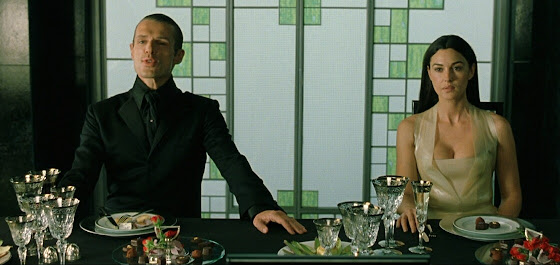
The Merovingian tells us that the French language is so beautiful that even the curses sound beautiful. He gives an example that's so shocking that it's omitted in the film's French subtitles. Was the studio ashamed to write what he said? His exact words are 

"Nom de dieu de putain de bordel de merde de saloperie de connard d'enculé de ta mère".

When searching online, I found several attempts at translating the curse into words that would be used in English, words like "goddamnit" and "motherfucker". These translations are inappropriate, because the whole point is to show that the French language has a curse which English doesn't have. This can only be expressed in the literal translation:

"Name of God of the whore of the brothel of shit of trash of the anus of the sodomiser of your mother".

Supposedly these words were ad-libbed by Lambert Wilson, the French actor who played the Merovingian, and the Wachowski Brothers liked the curse so much that they insisted on putting it in the film.

Success Rate:  + 3.8

Order from Amazon.com
Order from Amazon.co.uk
Order from Amazon.de

Wednesday, 6 July 2022

The Matrix (5 Stars)


Many people say that "The Matrix" is the best film ever made. I don't rate it quite that highly, but it's still in fifth place in my top films list, a very high position.

What do people like about it so much? Maybe it's better to ask what I like about it so much. It has dazzling kung fu action and breath-taking shootouts. It has delicious sci-fi imagery. It's laced with philosophical statements that question our reality. Then there's the heavy metal soundtrack that numbs our senses. And it's a love story. It's a film like none that went before it or have been made since.

There are probably other things I've forgotten, but I'll leave it at that.


Watching "The Matrix" is a significant happening in people's lives. We can remember where we were when we first saw "The Matrix". I sat at home watching it on television when I was going through one of the worst periods in my life. It offered me two hours of distraction when I needed it most. That was in America. When I moved back to England I taped it, and it was one of the first films I bought on DVD.


The film's dialogue is so deep and meaningful that hundreds of sentences can be picked and quoted. It's worth reading the whole script of the film's screenplay. It's easy to find online if you search. If you copy and paste random passages to your Facebook timeline, your friends will immediately recognise the quotes. "The Matrix" has become part of our culture. Expressions like "the red pill and the blue pill" have become part and parcel of the English language.

"The Matrix" was made in 1999. It could have been left as a standalone film, but two sequels were made in 2003. A lot of fans were disappointed with the sequels. I understand their disappointment. The first film was such a pinnacle that it was impossible to live up to it. I personally enjoy the sequels a lot. They answered open questions while asking new ones. There was yet another sequel in 2021 which I've only seen once. I consider the fourth film unnecessary, but I'll be able to say more about it when I see it again.

Needless to say, "The Matrix" is a film worth watching over and over again.

Success Rate:  + 5.4

Order from Amazon.com
Order from Amazon.co.uk
Order from Amazon.de

Wednesday, 29 December 2021

The Matrix Resurrections (4 Stars)


When this film was announced, 15 years after the third part, I groaned. What's the point? The Matrix trilogy was perfect as it was. Neo forged an alliance with the machines in order to eradicate the virus, Smith. Peace was made. The machines no longer tried to destroy Zion.

That's the question that I took with me into the cinema today. What's the point?

Let me explain it in a few words, without giving away any spoilers.

The film takes place 60 years after "The Matrix Revolutions". The peace treaty between the machines and the free humans has held. However, the Matrix is still necessary to provide the machines with the power they need. Neo died at the end of "Revolutions", but the machines somehow revived him and plugged him back into the Matrix to use him to keep the people in the Matrix contented. They also revived Trinity, though I don't understand why.

That's what the point is. The Matrix (a new version of the Matrix) is continuing without a war in the background.

The film is acceptable, though not up to the standards of the previous films. It's enjoyable, but it's unnecessary. It didn't need to be made. If it had been made at all, it should have been made shortly after the third film, when it was still fresh. Being made now, it looks like the studios are just trying to squeeze the last drops out of a cash cow. Will they succeed? I don't know. A friend of mine who works in the cinema told me that it wasn't performing as well as expected. Today, less than a week after it was released, the theatre was less than a quarter full. In comparison, "Spider-Man No Way Home" is still sold out every night in its second week.

Nobody wants to return to the Matrix.

P.S. Nobody except for me remained in the theatre to see the after-credits scene. Didn't they know about it, or didn't they care?

Sunday, 26 December 2021

The Matrix Revolutions (5 Stars)


The critics didn't like this film much. It only has a 35% rating on Rotten Tomatoes. That's all the proof we need that today's film critics are rotten. It's an excellent film that neatly ties up all the loose ends from the first two films. Peace is made between humans and the machines. There's no need for a fourth film.

Most of the people in the film are characters that we know from the previous films, but there are a few new faces.


The Trainman works for the Merovingian, transporting programs into and out of the Matrix.


Rama-Kandra is a program with human traits. He loves his wife and daughter. He believes in Karma. He's very soft spoken, and he makes an effort to explain to Neo that humans and computer programs aren't all that different. He tells Neo that he saw him visit the Merovingian in the last film. If you pay close attention you can see him in the Merovingian's restaurant.


Kamala is Rama-Kandra's wife. Sati is his daughter. It's not obvious where Sati should be sent. In the conversation with Neo it sounds like she'll be sent from the Matrix to the machine world, but later on it seems to be the opposite direction, because she's put in the care of the Oracle.

This is a very good film, whatever the critics say. I hope the fourth film is just as good.

Success Rate:  + 1.9

Order from Amazon.com
Order from Amazon.co.uk
Order from Amazon.de

The Matrix Reloaded (5 Stars)


I intend to watch the new Matrix film this week, either Tuesday or Wednesday, so I'm rewatching the second and third films today. I already watched the first film in September.

Most people say that the sequels aren't as good as the first film. I agree, but I still think they're very good. "The Matrix" could have existed as a standalone film, but the sequels made sense. "Reloaded" (to shorten its title) shows Neo as the reluctant Messiah. Some believe in him, others don't. Many ascribe omnipotence to him and ask him to look over their loved ones. That's a heavy burden for any man to bear.


Nobody is a more dedicated believer than Morpheus. He's spent all his like searching for The One.


The Oracle has prophesied the coming of The One. In "Reloaded" we learn that she's not what Morpheus and everyone else believed. She's not human, she's a computer program, written to give humanity hope. Hope can be something good, but in this case hope is used to keep humanity under control. Hope is intended to manipulate mankind. Hope has manipulated Morpheus. And yet Morpheus still believes. His belief is no longer in the words of the Oracle, it's in the person of Neo himself.

Let's apply that to ourselves. Many people believe in a religion. Let's take Christianity as an example, although it could just as well be any other religion. Imagine that we were able to meet and talk with the people who wrote the Bible, the Evangelists and Paul. Imagine that they told us that Christianity is a fake, and they only invented it to make us better people. How would we react? Would we just close our ears and continue with our belief system?


The Oracle's co-conspirator is the Architect. He's the one who designed the Matrix. First he made it perfect, and then he destroyed it and rewrote it with flaws to make it more realistic to its inhabitants. We find out that the current Matrix in which Neo lives is the sixth iteration. It's Matrix 6.0. The Architect is unable to make it fully acceptable to its inhabitants, so the Oracle adds the element of hope.


Agent Smith returns after seemingly being destroyed in the first film. Do you remember his definition of humanity?

"I'd like to share a revelation I've had during my time here. It came to me when I tried to classify your species. I realized that you're not actually mammals. Every mammal on this planet instinctively develops a natural equilibrium with their surrounding environment, but you humans do not. You move to another area, and you multiply, and you multiply, until every natural resource is consumed. The only way you can survive is to spread to another area. There is another organism on this planet that follows the same pattern. Do you know what it is? A virus. Human beings are a disease, a cancer of this planet. You are a plague, and we are the cure".

It's ironic that Agent Smith himself has now become a virus. The other Agents just take over one human body at a time, but Agent Smith takes over body after body, until ultimately he'll be the only person inhabiting the Matrix.


New characters join the film, such as Collin Chou as Seraph. The role was offered to Jet Li, but he turned it down. He said he was afraid that his martial arts moves would be digitised and copied by the studios. I don't understand that. Couldn't his moves be copied in other ways?


Other new arrivals are the Merovingian and his wife Persephone. This adds a new flavour to the mythology of the Matrix franchise. The Merovingian is a rogue computer program. He exists in the Matrix, but he doesn't obey the machines who created it. He's a smuggler who secretly moves programs into and out of the Matrix. 

"Reloaded" has an incredible 15-minute car chase that's worth the price of the film in itself.  "Reloaded" is a great film, even if I didn't include it in my top 100. It's a film that deserved to be made.

Success Rate:  + 3.8

Order from Amazon.com
Order from Amazon.co.uk
Order from Amazon.de

Sunday, 5 September 2021

The Matrix (5 Stars)


Made in 1999, "The Matrix" is a film that's revolutionised films, and not just science fiction films. The mixture of virtual reality, kung fu action and the bullet time cinematography has wowed audiences and critics alike.

The story isn't completely original. In 1984 "Terminator" had already predicted a world run by machines. The difference is in the application of the story. The machines in "Terminator" seek to eliminate the human race, apart from a select few who're required to work for them. The machines in "The Matrix" have put all of mankind into a virtual trance, a dream state. Mankind is enslaved, but doesn't know it. Only those who are particularly perceptive have a feeling that something is wrong with the world. It's not the real world at all, it's a computer simulation called the Matrix.


The film is full of religious imagery. Keanu Reeves plays Thomas Anderson, a computer hacker who uses to code name Neo. An ancient prophecy exists that a man will come who will save mankind from the machines. Neo is told that he is the One.


It's not so much religious imagery as religious hints. Neo is contacted by a mysterious woman called Trinity. He's told that the last free city on Earth is called Zion.


But before you think that it's only Biblical imagery, the prophecies are delivered by an Oracle. That's a name given to women who gave messages from the Greek Gods.

The film has a green tint throughout. When you watch it you might not notice it at first, because your eyes adjust to the greenness. It's just like the people in the Matrix who've grown used to what they see.


Even though Keanu Reeves plays the main character, I think the character who carries the film is Laurence Fishburne as Morpheus. He's the captain of the ship Nebuchadnezzar, but he plays a significant role because of a prophecy given him by the Oracle: he's been told that he would discover the One. How he recognises Neo as the One isn't stated, but he's so convinced that Neo is the Saviour that he's willing to sacrifice his life to save him.

One other way that "The Matrix" revolutionised cinema was the viewing habits. The first DVDs were on the market in 1996, but the advanced cinematography in "The Matrix" made it the film that encouraged people to buy their first DVD player.

Simply put, this is one of the best films ever made. It's a film that enthralls people who don't usually like science fiction films. It's a masterpiece. I feel like my short review doesn't do it justice.

Success Rate:  + 5.4

Order from Amazon.com
Order from Amazon.co.uk
Order from Amazon.de