Showing posts with label Dorothea Rau. Show all posts

Thursday, 14 May 2026

Geh, zieh dein Dirndl aus (4 Stars)


Released at the height of the Bavarian sex-comedy boom, "Geh zieh dein Dirndl aus" (i.e. "Take off your dirndl") is exactly the kind of film that critics usually dismiss with a shrug and audiences secretly remember with affection. It's broad, cheeky and utterly unconcerned with subtlety, yet beneath all the innuendo and slapstick chaos there's a fascinating snapshot of a particular moment in West German popular cinema. The film belongs to that strange early-1970's period when Lederhosen comedies became enormously profitable by mixing postcard Bavaria, sexual liberation and old-fashioned farce into one commercially irresistible package.

What makes the film especially interesting today is the presence of Dorothea Rau. She was never promoted internationally on the level of stars like Uschi Glas or Ingrid Steeger, but within the Lederhosen cycle she became one of its defining faces. Rau had an unusual screen presence for these productions. Many actresses in the genre were presented almost entirely as decorative fantasy figures; Dorothea Rau, by contrast, often projected intelligence, confidence and a slightly mischievous sense of self-awareness. She understood the joke the films were making and seemed to enjoy playing along with it.

In "Geh zieh dein Dirndl aus", that quality becomes essential. The film itself is assembled from the usual ingredients; misunderstandings, frustrated husbands, sexually adventurous tourists and endless opportunities for clothing to be removed at strategically comic moments. But Rau gives the material a spark that elevates it beyond mechanical sex farce. She moves through the absurd situations with complete confidence, never looking embarrassed or trapped by the material. Instead, she turns the film's exaggerated sexuality into part of the comedy itself.


Her importance to the Lederhosen comedies wasn't simply that she appeared in them; plenty of actresses did. What distinguished Rau was that she helped define the tone of the genre during its commercial peak. These films depended on balancing eroticism with friendliness. If they became too vulgar, audiences recoiled; if they became too innocent, audiences lost interest. Rau occupied that middle ground perfectly. She brought glamour and sensuality, but also warmth and humour. That balance helped make the films feel playful rather than aggressive.

Watching the film now, it's also striking how strongly the Lederhosen cycle reflected changing attitudes in West Germany after the social upheavals of the late 1960's. The films pretended to celebrate rustic tradition, yet they were really about modern permissiveness invading conservative environments. Dirndls, beer halls and Alpine villages became colourful packaging for stories about sexual freedom. In that sense, performers like Dorothea Rau were central to the genre's success because they embodied the contradiction. She looked perfectly at home within the traditional Bavarian imagery while simultaneously representing the more liberated attitudes the films were selling.

Artistically, "Geh zieh dein Dirndl aus" won't convert anyone who already hates the Lederhosen comedies. The jokes are repetitive, the plotting barely matters and the filmmaking is functional at best. Yet the film survives as an entertaining cultural artefact and as a reminder of how important performers can be within supposedly disposable cinema. Dorothea Rau may never have become a major international star, but within this uniquely German subgenre she was one of its defining personalities; charming, playful and absolutely essential to its appeal.


I was excited to find out that Dorothea Rau grew up in Münchingen, the village where I live, in a small house next to the cemetery. The address is Kontaler Straße 18. People who remember her think of her as a scandalous porn star. They don't get it. There was never any real sex in the Bavarian sex comedies or in any of the German erotic films of the 1970's. People were fast to judge things that they knew nothing about.

Wednesday, 22 September 2021

Geh, zieh dein Dirndl aus (4½ Stars)


This is a Bavarian erotic comedy made in 1973. It's generally considered to be the first film in its genre, setting the pattern for many films with Lederhosen and Dirndls in the following years. The title means "Take your Dirndl off", as Dorothea Rau is doing in the photo above. In America the film was released as "Love Bavarian Style". I hate it when they arbitrarily change film titles!

Gisela Horn, a woman from Berlin, has bought a farm in the Bavarian alps, close to the Austrian border. This is met with hostility by the locals, who consider her to be a Prussian. They use the derogatory word Preißin when talking about her. Worst of all, she's a very moral person. She's always complaining about the farm employees having sex when they should be working.


This is Gisela, played by the famous German actress Elisabeth Volkmann. She doesn't fit in because she doesn't even wear a Dirndl.


Nobody fills a Dirndl as well as Dorothea Rau. She plays Resi, a waitress at the local inn.

Life in the village is further disrupted when a car breaks down carrying four Italians. Count Traverso of Venice has sent his two daughters to Germany to learn the language. Vittorio (Rinaldo Talamonti) is the chaperone, and Mario is the driver. They're on their way to Bielefeld, but the car crashes because the driver is gay and can't keep his hands off Vittorio. They have to stay at the inn.

The film doesn't have much of a plot, but I love it anyway. It's a series of comic sketches that kept me laughing out loud. Naked women, inappropriate humour, constantly changing partners with people running in and out of one another's bedrooms. Many of the 1970's German films are called Erotic Classics, but the term is used too lightly. "Geh, zieh dein Dirndl aus" is a true classic. It deserves a digital remastering to clean up the picture.


Any film with Rinaldo Talamonti is worth watching.


So is any film with Dorothea Rau.


Do you prefer her with or without a Dirndl?


Sadly, she gave up acting after only three years, leaving 21 films behind her.


Rinaldo is a gentleman. He tries to look into Dorothea's eyes when he talks to her.


Oh well, at least he tried. At his height it's difficult to resist temptation.


And the film ends with a Lederhosen dance, complete with stomping and leg slapping.

I can tell you, this dance isn't just comical for foreigners. Even Germans from other parts of the country find the Bavarian traditional dances hilarious. I'm sure that the director Siggi Götz (aka Siegfried Rothemund) was aware of this. This was his first film, and he's still making films today. 

Here are a few lobby cards that I found online. I wish I had the originals.


Sunday, 5 September 2021

Sex Dream Report (3½ Stars)


This is a German erotic comedy that was released in 1973. It was directed by Walter Boos, who's best known for directing the Schoolgirl Report films. This film follows a similar pattern of short stories separated by interviews on the street. Dr. Heinz Kahlbaum is gathering material for a book on sexual dreams. Together with his assistant Gisela he's standing at Karlsplatz in Munich asking passers by about their dreams. Most of the people he asks refuse to answer, but there are five vignettes based on the replies he receives.


1. The first person to give a detailed answer is the bus driver Willi Wasmuth, played by Josef Moosholzer. He's 35, and his wife Erna is 30. By all accounts, he's an unpleasant person. When he gets home from work he orders his wife to fetch him a beer. No please or thank you. Then he falls asleep in front of the television. He dreams that the weather girl strips naked and seduces him. His wife is so beautiful that I don't understand why he prefers dreams to reality.


2. The second man who answers is Max Gickes, a sculptor. He says that he dreams of owning a harem. Four sexy dancing girls take turns having sex with him, while a fifth fans him to keep him cool. Gisela finds the dream strange, but Dr. Kahlbaum tells her it's a typical male fantasy. Then Max tells them that the dream is based on his real life. He shares an apartment with four women. He sleeps with Anna on Monday, Betty on Tuesday, Cecilia on Wednesday and Daisy on Thursday. This wears him out, so he goes home to his wife for the other three days. Obviously Max doesn't know the difference between truth and fantasy.


3. Another man who gets dreams mixed up with reality is Dieter Haberkorn, a travel agent. Every day he gets a parking ticket from the beautiful traffic warden Monika, played by Ulrike Butz. He tells her that they've had a relationship, but she tells him that he's mad. We see his ridiculous fantasy of them having sex in a courtroom. He really thinks it's happened. He persuades her to go on a date with him, but he insists that she wear her uniform. Or is this yet another dream? I don't know. All I can say is that I'd also dream about any policewoman as beautiful as Ulrike Butz. She was the sexiest German actress of the 1970's. Her career only lasted from 1972 to 1974, during which time she made 27 films.


4. Eugen is a medical student. He marries Franziska, the butcher's daughter, played by the delightful Dorothea Rau. On the wedding night he can't perform – What!!! He can't get it up for Dorothea Rau??? – so she does what any disappointed bride would do: she hits him over the head with a chamber pot and puts him in hospital. While he's recovering he dreams about marrying the nurse who's looking after him. The dream cures him, and he's able to go home to his happy wife.


5. The final interview takes place spontaneously. Dr. Kahlbaum and Gisela visit a restaurant, where they talk to the waiter Tonio, played by Rinaldo Talamonti. He says he's always had a crush on the restaurant's owner, Karla Marquadt. Isn't she a bit too tall for him? After months of dreaming about her they finally got together.


Some report films are better than others, but they're never original. I knew what the final scene would be before I watched it. Gisela confesses that she's been dreaming about making love to Dr. Kahlbaum. She tells him about her dreams and attempts to seduce him. At first he resists. He wants to remain professional, but eventually he gives in. The End.

This isn't one of the best German erotic comedies of the 1970's, but it's amusing and worth watching at least once. I intend to watch more German erotic comedies over the next few weeks. I don't know how many yet. I'll decide as I go along.


Monday, 30 November 2020

Housewife Report 5 (3 Stars)


The fifth film in the Housewife Report series was made in 1973, the same year as the previous instalment. The film's original title, as it appears on the splash screen, was "Housewife Report International". Instead of reporting on housewives in Germany, the reporter Bernd Mittler is sent to interview women all over the world. His wife Brigitte stays at home in Munich to look after their newly born baby. We heard at the end of the third film that she was pregnant, and now we see the cute little boy.

1. The first segment takes place in Budapest. Ilona is sad that her husband Shandor only has sex with her once a month. Her downstairs neighbour Marika is sad that her husband Istvan demands sex from her twice a day. They agree to swap their husbands. In Socialist countries goods are distributed fairly, as the voiceover says.

2. The second segment takes place in London. Grace and Richard Stevenson have been married for six years. Richard believes in keeping a tight schedule in his life. He leaves for work and returns home at the exact time every day. They have sex every Wednesday evening, and it has to last exactly 20 minutes. Grace enjoys the sex, and these 20 minutes are the highlight of her week, although she wishes she could have more. Her teenage nephew Martin visits them, the son of Richard's brother. He's still a virgin. Grace seduces him, and they have sex every day for a week. Martin wants to run away with Grace, but she sends him back home to his parents. She just wanted some variety. Now she can go back to her 20 minutes a week.


3. The third segment takes place in Madrid. Don Geronimo owns a shop selling religious icons, and his wife Dolores stays at home with their four children. He's a strict Catholic, and he says that sex is only for making babies. There's no more sex for her until she's ready for her fifth child. Dolores feels attracted to her neighbour, who isn't named in the film, but he's played by the fiery Italian Rinaldo Talamonte. I suppose Italians and Spaniards look the same. Rinaldo visits the home regularly disguised as a nun.


Dolores is played by the famous German actress Elisabeth Volkmann in one of her early roles. In later years she distanced herself from her erotic movies. Why? She had a lot to offer, and she didn't need to be ashamed of it.


Rinaldo and Elisabeth pose for the camera.


4. The fourth segment takes place in Coxville, America. Supposedly it's 42 miles north of New York, but the only towns called Coxville that I've been able to find are much further away in other states. Three families live next door to one another. The husbands commute to New York City every day. They work together and spend their evenings together. They don't have much time for their wives. On Sunday the wives go to church together, but for the rest of the week they're bored. They all visit a psychiatrist who has sex with them to make them feel better. Connoisseurs of German erotic films will recognise Ingrid Steeger on the left and Dorothea Rau in the middle.

5. The fifth segment takes place in Paris. Janine and Girard are visiting from a small town in France. They've been married for three years, and the passion has gone from their marriage. Due to confusion at the train station they get separated when they arrive. Janine doesn't know the name of their hotel. She meets and falls in love with a taxi driver, so she leaves her husband.

6. The sixth segment takes place back home in Munich. Linda Holzinger is single and looking for a man. She's devoted to Wagner's music, so any potential husband has to love Wagner. After dating two men unsuccessfully, she meets the triangle player in a large orchestra.


There are scenes from Bernd and Brigitte's happy family life in between the segments. Some of the scenes give me a queasy feeling in my stomach. I'm not saying they're bad, it's possible that the problem lies with me. I'll let others decide. In most of the scenes Bernd and Brigitte are naked while their baby crawls around. Okay, there's nothing wrong with babies seeing their parents naked, but the two actors weren't married in real life, so the small baby (probably less than a year old) wasn't their child, he was just playing the role. Possibly he was the child of Angelika Baumgart, the actress who plays Brigitte, so he was seeing his mother nakes with another man. Should small children appear in nude scenes with adult actors? Let me know what you think.

This is the weakest of the Housewife Report films so far. The first five segments have the same theme: married women don't get enough sex, so they need to look for adventures outside of their marriage. The sixth segment doesn't fit. The woman isn't even married. Every segment (even the sixth) relies on national stereotypes for humour.

P.S. At the end of the film Brigitte tells Bernd that she's expecting a second child.

Friday, 16 October 2020

Housewife Report 4 (4 Stars)


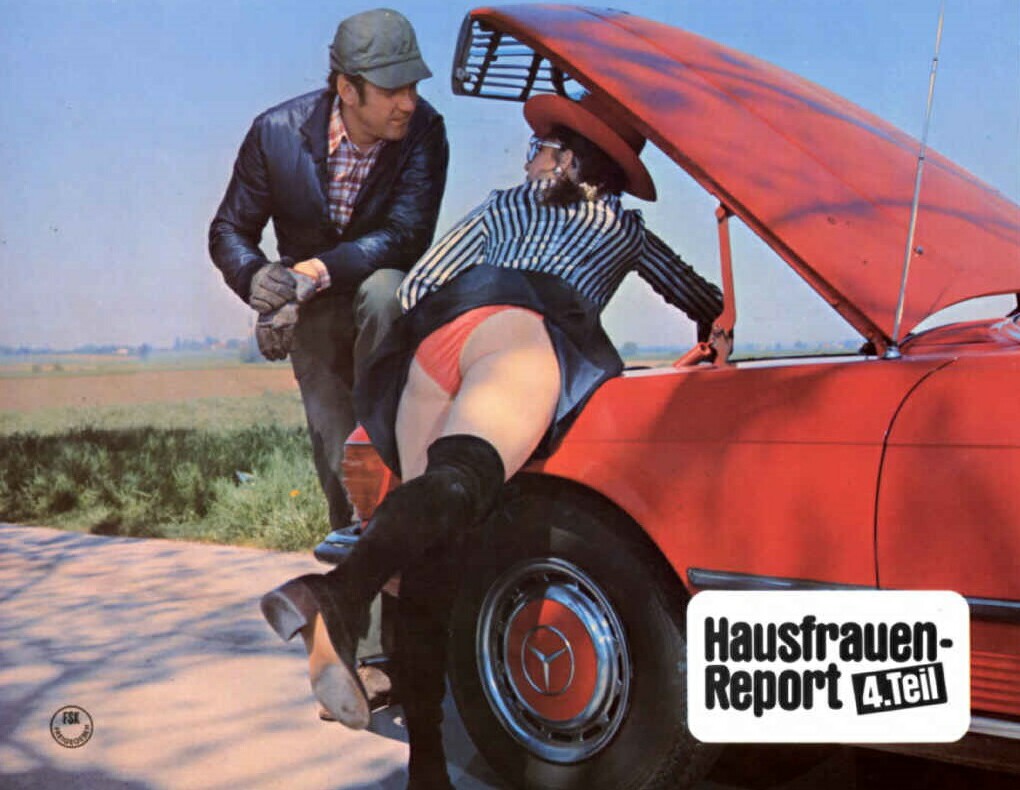
My readers who have been following my Housewife Report posts will immediately recognise two of the actors in the picture above. On the left is Rosl Mayr, and on the right is Gernot Möhner, who appears in all the Housewife Report films as the investigative reporter Bernd Mittler. I can't name the man in the middle, because there are no credits, and I don't recognise him from other films.

Whereas the previous film offered socially dubious messages about divorces in Germany, this film plays it safe and has no messages at all. Instead of beginning in an office, like most report films, it takes place in a railway carriage. Bernd Mittler catches a train in Hamburg and is heading southwards, probably back home to Munich. The businessman sitting next to him says he knows him; he's seen him in stupid sex films. Bernd objects, replying that they're serious scientific studies. The other two men in the carriage join in the conversation. There's a lawyer sitting opposite who says, "The scientific value of your films is very questionable". In the corner there's a Catholic priest, who adds "I've seen the films, and they should be taken seriously. They show what comes from living in a prudish society". I like the priest. He's a very open person who talks good sense.

Bernd attempts to defend his reputation as a serious reporter by telling them the results of his recent interviews in cities all around Germany. We don't see Bernd himself in the vignettes, we just see what he's been told.


1. The first story takes place in Berlin. Gerda and Fritz have been married for five years. Gerda loves her husband and wants to have more sex with him, but he's bored and would rather watch television than have sex. What an idiot!


She orders a company to take away her old, heavy furniture, and a muscular man called Paul comes to carry everything away. Gerda is excited and seduces him. That's not enough. The next day she arranges to meet him at home.


While they're making love, Paul's girlfriend comes home. She isn't jealous. She thanks Gerda for warming up her boyfriend and says that she'll take over. Gerda is miserable and rushes home in tears. When her husband sees her he doesn't know what's wrong, but he feels sorry for her, so they go to bed and make love.

So what's the message of this story? You tell me.

After this story, Rosl Mayr joins the men in the carriage. She says she's a virgin, but there's no hint of innocence in her. She talks openly about sex and women's right to do it as often as they like. She's seen the previous Housewife Report films and joins in the conversation. The lawyer says that in marriages there are two sides to every story, to which she replies, "There aren't two sides. Women are always right".

Now you know why I love Rosl Mayr so much. She was phenomenal in every role she played.


2. The second story takes places in Hamburg. Herbert is a wealthy businessman who lives with his wife Elke, played by the famous German actress Elisabeth Volkmann. She began her career in erotic films, but when she became a serious actress she distanced herself from them. Elke is sexually adventurous, but Herbert just wants to do the missionary position. We see her pulling him from one impractical position to another.

The next day, Herbert interviews an applicant for a position as housekeeper. The woman, played by the deliciously curvy Dorothea Rau, rips her clothes off and tries to seduce him. Elke walks in and tells Herbert she'll handle the other interviews.


The next applicant gets drunk during the interview, so Elke turns her down. The third applicant is a beautiful lesbian who seduces Elke. Hired! Elke says that she's too good to do housework, so she gives Herbert an apron and makes him do the housework while the women enjoy their sex life.

The message? Men should be the slaves in lesbian households.

Another woman comes into the carriage. Now all six seats are occupied. She's a medical student called Marianne. She defends women's right to have as much sex as they want with whoever they want.


3. The third story takes place in Mainz. Doctor Fridobert Walzel is a Professor at the University of Mainz, teaching Entomology. I had to look that up as well; it's the study of insects. His young wife Dorothee is unhappy, because he's more interested in the mating habits of insects than mating with her. One Saturday morning he leaves home early, because he wants to watch the mating act of two insects that only takes place once a year. The insect's name is corpus facilitis, if I understood it correctly. During mating the female shouts "Bee" while the male shouts "Tak Tak". Fascinating.

Two research students should be accompanying Doctor Walzel to the woods, but only one arrives. After they leave the second student arrives, a handsome young man, and he asks Dorothee to drive him to the woods. They go to the woods, but they get distracted. They have wild sex, in which she yells "Bee" and he yells "Tak Tak". It's so funny that I had to laugh out loud. Meanwhile, the female research student accompanying Doctor Walzel takes off her clothes and seduces the professor. While they're making love, he hears the Bee-Tak-Tak-ing and thinks the insects are close. They're on the floor doing it doggy style, so he pushes her towards the noises... and the two couples discover one another in the act.

The message? When you're making love in the woods, don't do Bee-Tak-Tak.


4. The fourth story takes place in the small town of Neustadt in Hessen. Karin and Heinz are a happily married couple, apart from the fact that Heinz is a truck driver who is often on the road for days. While Heinz is gone one day, Karin meets a hot young Spaniard called Juan, played by Rinaldo Talamonti. He does his best to put on a Spanish accent, but he can't disguise the fact that he's really Italian. Karin takes him back home for sex, and they have a long session of foreplay in which Juan pretends to be a bull while Karin is the matador. I should try it some time, it looks like fun.


Meanwhile, Heinz has stopped to help a woman with car troubles. It was a trap. The woman, Hildegard, was only pretending to have car troubles so that she could lure a man for sex. The story ends with a strange scene. Heinz is in bed being ridden by Hildegard, and he feels the need to check up on his wife. He calls her, and she answers despite being in the middle of sex with Juan. They talk on the phone, both acting normally, but both are worried because their partner sounds out of breath.

The message? I have absolutely no idea!


5. The fifth and final story takes place in Stuttgart. I know Stuttgart well, so I tried to figure out where it was. Eventually I saw a street sign and realised that it wasn't filmed in Stuttgart, it was Grünwald, a small town just south of Munich. Sieglinde is married to an older man called Lambert. He works two jobs so they'll be able to buy their own house, which is the dream of every Stuttgarter. In the evening Sieglinde wants to go to the fitness studio, but Ottokar, a young man from Dresden (DDR) arrives selling magazines. She doesn't want to buy anything, but she's willing to have sex. After this he leaves.

Meanwhile, Lambert is at his second job. He's seduced by his secretary, Gudrun, who's played by Ulrike Butz. She was the most beautiful German actress in the 1970's. Nobody else came close. After sex they both go home. When Lambert arrives home he's surprised to find Sieglinde at home, and she's surprised that he's come home so early. But the fickle fingers of fate are at work. Ottokar sees Gudrun in the street and chats her up. They tell each other they were just with someone, and when they say where they live they realise it was the same couple. Ottokar and Gudrun walk together to Lambert and Sieglinde's apartment. They wish the surprised couple all the best for their married life and leave together. Lambert tells his wife he'll quit his second job, because a happy marriage is more important than buying a house.

And that's the message of the fifth vignette, I guess.

It was my intention to only use the lobby cards for illustration, since I've found a full set online, but I think the following screenshots will be a welcome addition.


For all her fans, this is the amazing Rosl Mayr.


Herbert can't handle Dorothea Rau. Could you?


This is Herbert's fate as the emasculated cuckold of lebian lovers.


And here's another photo of Rosl Mayr. I know you want it!


Rinaldo Talamonti is a small man, but all the girls love him.


"Karin! You want me to do what?"


"Are you sure you don't want me to stand on a chair?"


"I need to hide! That was the doorbell!"


Can Karin tame the Spanish bull?


He's more of a bullock than a bull.


She got him!


But he likes it!


Ulrike Butz only appears for five minutes at the end of the film, but she's worth waiting for.


She's beautiful all over, face and body.


Lambert worships her as a Goddess.


Rosl Mayr approves. All women should be treated as Goddesses.

It's difficult for me to rate this film. It's not quite as good as the previous film in the series, but any film with Ulrike Butz and Rosl Mayr deserves four stars.