Showing posts with label Milan Peschel. Show all posts

Monday, 6 October 2025

Die Schule der magischen Tiere 4 (4 Stars)


The fourth film in the "School of Magical Animals" has been released 12 months after the third film. The studio wants to keep the German fans happy, and so far there's no sign that the fans are losing interest in the films. Disney could learn a lesson from the Germans.

There are plans to close the school and sell the castle in which it's situated. It's a private school, and there aren't enough enrolments to finance the school. The children can only see one solution. There's a school challenge, in which four schools are competing against one another to carry out physical and intellectual tasks. They say that if their school wins the challenge the popularity will lead to new enrolments. They receive help from Miriam, a new girl who's transferred temporarily from one of the rival schools.


The main cast is the same as in the previous films, but in this film more emphasis is on Leonie. While everyone else is fighting to save the school, she's dealing with a crush she has on Max.

Like the previous three films, it's good action mixed with fantasy and comedy from start to finish. The films can carry on forever... as long as the teenage actors don't get any older.

Sunday, 22 September 2024

Die Schule der magischen Tiere 3 (4 Stars)


This is the third film in the series, and the title means "The school of magic animals". It's based on a series of children's books, of which 29 volumes have been published since 2013. Twenty-nine books in eleven years? Wow, someone has been busy!

Unlike the previous two films, most of the action takes place outside the school. In the opening scenes two new magic animals are introduced and given to deserving children, a crocodile and a cat. Both of them can talk, and both are able to turn themselves into unmoving stuffed animals at any time; usually when someone walks into the room who isn't allowed to see them.

The children are planning an event to show their support for the local forest. They don't want the trees to be cut down to make way for a luxury hotel. The trouble is that after months of planning it's announced that the fashion designer Maja Malakara is putting on a fashion show in the local museum. That doesn't matter to most of the class, but the 16-year-old Helena is a moderately successful YouTuber, and she wants to boost her popularity with a live broadcast of her class singing at the show. Can she persuade her classmates to abandon the forest for the sake of her YouTube fame?

I say that Helena is 16, but that's only a guess. The children look and act that age. It's 18 months since the last film was made, and fortunately the actors don't seem to have aged much. They won't stay young for the next 26 films. Make up artists can't work miracles, however good they are.

I've tagged this film as a musical. My definition is that a film is a musical if the main characters burst into song at random during the film. A film isn't a musical if the characters perform a song as part of the story. That's why I say "Rocketman" is a musical, but "Bohemian Rhapsody" isn't. I make the further restriction that a film isn't a musical if the main characters only sing at the end of the film, during or immediately before the credits. That excludes "Slumdog Millionaire". If I remember correctly, there are two scenes in "Die Schule der magischen Tiere 3" in which there are spontaneous musical numbers.

It's a good film. Oliver loved it, and he's already asking when the fourth part will be released. Personally, I don't think it's quite up to the level of the previous film, but I'll decide when I watch it again. It's definitely worth a rewatch.

Wednesday, 21 August 2024

Die Schule der magischen Tiere 2 (4½ Stars)


It's the school holidays at the moment, so I'm letting Oliver decide what he wants to watch. He loved "Die Schule der magischen Tiere 2" ("The school of magic animals") when we saw it in the cinema, so he was overjoyed when he saw it was available on Amazon Prime.

The title comes from the habit of an explorer to bring children magic animals once a year. There are only a couple of animals each year, and the animals themselves decide which child it wants to adopt, or rather be adopted by. They're natural animals, such as parrots, penguins or foxes, but what's magic about them is that they can change themselves into stuffed animals whenever necessary. It's often necessary, because wild animals aren't allowed in school. The only person allowed to see the animals in their true form is Miss Cornfield, the explorer's girlfriend. She's in on the secret.

How old are the children? My guess is that they're the 10th class, i.e. 15 and 16. They looked a lot younger in the first film, made two years previously. That's a problem with series of films about children. The actors grow so fast, so their development has to be built into the films. In the case of the Harry Potter films it was done very well. Each film was a new year in school. The magical animal films are a bit more chaotic. Two more sequels have been planned, and if they're not made fast the boys will have beards and the girls will look like old women.

Surprisingly, the film deals with subjects that aren't directly related to the magical animals themselves. A play is being made to celebrate the school's 250th anniversary. The headmaster has written a screenplay about the school's founder, but there are doubts whether he really was the founder. Miss Cornfield knows more than she's willing to tell. There's a mean girls clique that wants to derail the play and make themselves the main actresses, even if they don't have the required acting skills. They have good looks, but that's not all that's needed.

I'm glad Oliver persuaded me to watch the film again. I can hardly wait to see the third instalment in the cinema later this year.

Wednesday, 10 May 2023

The Pasta Detectives 2 (4 Stars)


This is a sequel to "The Pasta Detectives", made a year later in 2015. The original title is "Rico, Oskar und das Herzgebreche", engl. "Rico, Oskar and the Heartbreak". In my review of the first film I remarked that the English title doesn't make sense, because there's no pasta anywhere in the film. Now it's got one step closer to making sense. It's claimed that Rico's father is an Italian. Duh! I should have guessed, with a surname like Doretti!

The film is based on the second book in the best selling series about the schoolboys Rico and Oskar, written by Andreas Steinhöfel. It evidently takes place a few weeks after the first film. Oskar has spent some time with his father. Now he's coming to stay the night with Rico. Only one night is planned, but the following morning a suitcase with clothes is left outside Rico's apartment with a note, "Mrs. Doretti, I hope it's okay for Oskar to stay a few days longer. I need more time for myself". Oskar's father didn't even come in to tell Oskar himself. This is the first heartbreak. What sort of a father is he?


In the first film Oskar always wore a bicycle helmet. Now he doesn't, and he tells Oskar it's because he's incognito. I don't know who he's hiding from, but he's obviously suffering from paranoia. In addition, Oskar also wears dark sunglasses whenever he leaves Rico's house so that nobody will recognise him. That's a remarkable disguise.


One thing I didn't mention in my last review is that Rico's mother Tanja goes out to play Bingo several times a week. Ugh. My mother took me to Bingo clubs a few times when I was young, and I found it remarkably dull. Tanja is remarkably lucky, winning the top prizes. Can you see the way Oskar is looking at her? He can see that she's cheating. She's put her counters on the wrong numbers.


If you've ever played Bingo – poor you! – you know that the numbers are checked when you shout Bingo. The bingo caller, Mrs. Wandbek, checks Tanya's numbers and says they're correct. Oskar insists on investigating, and he discovers that Rico's mother is involved in a racket. Tanja wins expensive items, sells them on Ebay, then gives the money to Mrs. Wandbek. Oskar also finds out that Tanja isn't acting illegally by choice, she's being blackmailed. I shan't give any more spoilers, except to say that it involves spectacular car chases through Berlin and the surrounding countryside.


Karoline Herfurth looks too sweet and innocent to be a criminal!


The second heartbreak concerns the policeman Simon Westbühl, who recently moved into a fourth floor apartment in Dieffenbachstraße 93. Rico's already decided that he wants Simon as his new father, but he finds out that Simon has another woman living with him.


The twins Mele and Afra visit Rico. The one on the left, whichever her name is, says she wants to kiss Rico, but they laugh at him when he says Yes. What a tease! Is that yet another heartbreak?


They also flirt with Oskar. Isn't he too young for them?


Tanja is lost in thoughts. Does she think she still has a chance with Simon?


She falls asleep in front of her computer. That's something I've never done.

At the end of the film there's a surprise, which I'll mention here, because it might be important in the next film. Until now, Rico has believed that his father was dead. Now Tanja tells him he's still alive. She left him because he was hitting her.

That's a dilemma for a 10-year-old boy like Oskar. Can he still love his father under circumstances like these? It's possible for a man to be a good father, but a bad husband.

Sunday, 7 May 2023

The Pasta Detectives (4 Stars)


The original title of this German film is "Rico, Oskar und die Tiefferschatten", engl. "Rico, Oscar and the Deep Shadows". The title of the English release is very random, since there isn't any pasta in the film. At least there are detectives: Rico and Oskar.

The film is based on the first book in a series of books about the schoolboys Rico and Oskar. At least, I hope they're schoolboys. We never see them going to school. It's the summer holiday, I hope.

Rico Doretti is a 10-year-old boy who lives in a second floor apartment in Dieffenbachstraße 93 in Berlin. It's curious that the exact address is repeatedly named in the film, as if it's something important. It's a real house in Berlin. The area around his house can easily be recognised in Google Streetview. Most of the characters in the film live in the same house, which is six floors high. It's a typical Berlin apartment house.


That's the house. It's in the middle of Kreuzberg, an area in Berlin which has a bad reputation, but it's actually very attractive.


Rico lives with his mother Tanja, played by the stunningly beautiful actress Karoline Herfurth. She's struggling to make ends meet after the death of her husband in a fishing accident. She works all night in a nightclub, "Die Mausefalle" (engl. "The Mousetrap"). Rico has to put himself to bed, and his mother is still at work when he wakes up in the morning. Maybe that's why he doesn't go to school?


That's the club where Rico's mother works. Maybe not all of Kreuzberg looks so good.


And here's a close up of Tanja riding her bike home from work in the morning. In the film she complains about getting older and losing her looks, but come on! I'd run after her without hesitation, if I could keep up with her bike.


This is Rico's bedroom. Wow! I never had a room that big, even as an adult! He just needs some more furniture.


The twin sisters Mele and Afra live next door on the second floor. Rico is in love with them, but they make fun of him because they think he's stupid. How can he be in love with both of them at once? I've never known any twins, so I suppose it's difficult to choose.


A handsome young man called Simon moves into an apartment on the fourth floor. Later in the film we find out he's a policeman. He makes a round of the house, introducing himself to his new neighbours. Rico thinks he would be suitable as a new father, so he plays matchmaker, which embarrasses both Tanja and Simon.


Rico meets Oskar, an eight-year-old boy who lives somewhere close by. He refuses to give Rico his address. Oskar is highly intelligent, but he suffers from paranoia. He wears a helmet all the time, because he says Berlin is a dangerous place. Rico is jealous of Oskar because he has a father, but Oskar says his father doesn't love him.


That's the introduction. Now for the story. Berlin is living in terror. A man is kidnapping children and only giving them back if he's paid 2000 Euros. The press call him Mister 2000. Tanja warns Rico not to go out alone. Oskar does the opposite. He walks the streets, setting himself up to be captured. He wants his father to prove his love by paying 2000 Euros. Eventually Oskar is kidnapped, but his father won't pay. Rico goes to work, using his detective skills to find where Mister 2000 lives. He proves himself more skilful than the police.


This is a very good children's film. My grandson Oliver had no trouble relating to it, and he wants to see the sequels as soon as possible. In my opinion, the best children's films are the ones that adults can enjoy as well, and this is one of them.

Sunday, 2 April 2023

Die Schule der magischen Tiere 2 (4½ Stars)


This is a sequel to "Die Schule der magischen Tiere" ("The school of magical animals"), made in 2022. At the moment it's already out-performed the box office success of the first film, and it looks certain to be the most successful German film of 2023. (It was released late in 2022, and it's still in the cinema now).

Miss Cornfield has kept her promise that more of the children in the class will be given a magical animal. Jo, short for Jonathan and pronounced Yo, is given a penguin, and Anna-Lena receives a chameleon. I never realised that they're animals native to Sweden. That's why they're magical.


Most of the actors have returned from the first film. I don't remember seeing Anna-Lena before, but Jo was a prominent character in the first film. When child actors are aged 11 to 13 we can expect them to grow fast, but Loris Sichrovsky, who plays Jo, is the most extreme example. In the first film he was a typical young boy, but now he's shot up a few inches in height. He's the most handsome boy in the class, the boy all the girls want, and there's a romance between him and Ida.


Other developments are more in the personalities than in the looks. Helene, shown on the left, has become a stereotypical Mean Girl. She's the head of a clique who obey her every word. She wants Jo for herself, and she'll stop at nothing to get him.


Anna-Lena is one of the clique, but only because she wants to be accepted. Helene is using her. Anna-Lena is a skilled seamstress, and she makes dresses for Helene without receiving anything in return.


What a beautiful school! It's actually Wernigerode Castle in northern Germany, about 60 miles south-east of Hanover.

The film is about two seemingly unrelated matters. The class is putting on a musical play, written by Ida, about the founding of the school. Helene wants to take control of the play. Anna-Lena is by far the best singer, but Helene insists on taking the lead role for herself.

Someone is digging holes in the school's courtyard at night. However fast the caretaker fills them up, new holes appear the next day.

My first impression is that this is a better film than the first film. I enjoyed it, and the children in the cinema enjoyed it. There was loud laughter throughout the film. Most of the children were aged 6 to 10, but there were a few children in their early teens. It's something for every age. Sitting next to me was a lady with her six-year-old son. She told me it was his first visit to a cinema. I told her that Oliver visits the cinema every Sunday, and I hope to see her again soon.

According to Wikipedia, the next two sequels will appear in the cinema in 2024 and 2025 respectively. By that time the children will all look a lot older. I'm curious how the films will me.

This is a film that I want to see again soon, as soon as it's available on a streaming service. I might even buy it on disc.

Friday, 31 March 2023

Die Schule der magischen Tiere (4 Stars)


The name of this German children's film means "The school of magical animals". It was made in 2021, and it's based on a book with the same name. It takes place in an unnamed German town. I tried to narrow it down, but it was filmed in several different locations in Austria and Bavaria. It centres around a class in the prestigious Winterstein school. The age of the children isn't named, neither in the film nor the book, but the actress who plays the main character, Ida Kronenberg, is 11 years old. We can assume that the children are in the school's Year 6, which would be the first year of a senior school in Germany.


Ida has just moved to the town with her mother, who's opened a new hairdressing salon. As you can expect, it's difficult for a new girl to fit in. Nobody lets her sit next to them in class. 


Her only friend is Beni, who's also an outsider.


The class has a new teacher, Miss Cornfield. She says she's from Scotland, but she has a perfect German accent. That's hardly surprising, because she's played by the German actress Nadja Uhl. The class's first reaction is negative, because she looks like a witch, but they soon accept her when she says that school is more about having fun than learning. She wants the class to be a magical community. Two of the children will be selected to receive magical animals, and others will follow.


Miss Cornfield has a friend called Mortimer, presumably Scottish as well, whatever nationality the actor is. He knows a place in Sweden where intelligent talking animals live. He frequently drives there to collect animals for Miss Cornfield's class. The two children selected to receive the animals are Isa and Beni, which is no surprise. What does surprise me is that the other children aren't jealous. Ida is given a fox called Rabbat, and Beni is given a tortoise called Henrietta.


The animals are a secret. Nobody outside the class is allowed to see them, especially not the headmaster, Mr.  Siegmann.


That's the background for the story itself. Someone is stealing things from the school, such as the school clock. The headmaster tells the school caretaker to investigate, without success. Ida, Beni and their animals are the only ones able to find clues.

And no, I have no idea why the two children at the front have Rubik's Cubes.


"Yes, Miss Cornfield, we promise to leave our Rubik's Cubes at home!"

This was the most successful German film in cinemas in 2022. Deservedly so. Even though it's a children's film, it has elements that can be appreciated by adults. It doesn't have the depth of complexity of the Harry Potter films, which makes it easily accessible to young children. Its age rating is 0. It deserves to be shown outside of Germany.

Friday, 16 December 2022

Der Hauptmann (4½ Stars)


Bones. Skeletons. Dumped in the forest to decay, the flesh eaten by wolves and other wild animals.

In most films about the Second World War the skeletons would be the bodies of Jews slaughtered by the Nazis. "Der Hauptmann" (engl. "The Captain") is different. Jews aren't mentioned once in the film. The bodies in the picture are German deserters, killed by their fellow soldiers.

If I'd been fighting for Germany in the Second World War, I would have deserted. If I were a Russian conscripted to fight Putin's war in Ukraine, I'd look for a way to surrender as quickly as possible. Ukraine has even set up surrender hotlines to advise Russian soldiers how to give themselves up. That's wonderful. The quality of a country can be seen in how it treats its deserters and others who refuse to fight. In the 1940's England had many conscientious objectors who refused to fight. The assumption (not always correct) was that they were afraid to fight, so they were offered non-combat roles at home, such as working for the fire brigade. They were only imprisoned if they refused the jobs offered or made it obvious that they didn't oppose Hitler, and they were never, never executed.

There's a big difference between Ukraine and Russia. Ukraine is a free democratic country. Russia is a Fascist state ruled by a dictator who won't quit until he's killed. Fascist countries kill those who refuse to fight, because they're scared of opposing voices. Russia isn't a bad country in itself. It has a long history of literature and the arts. The problem is its vile leader who pretends to love Russia, but is only pursuing his own glorification. He thinks he will be revered as a man like Stalin who's made Russia great again. (I'd be ashamed to be compared with a mass murderer like Stalin, but I shan't go into that here). History will be written differently. Vladimir Putin will be remembered as the man who ruined Russia, wrecking the economy and sending millions of young men to die in a futile war.

The only hope for Russia is that Putin will die soon. He needs a bullet in the back of the head, so that a new leader can save Russia and make it a beautiful free country again.

Order from Amazon.com
Order from Amazon.co.uk
Order from Amazon.de

Saturday, 26 February 2022

Der Hauptmann (4½ Stars)


Name: Willi Herold
Lived: 11 September 1925 – 14 November 1946
Film dates: April to May 1945
Film made in 2017

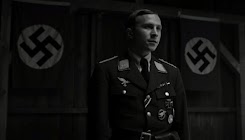
I was lucky to see the German premiere of this film, attended by the Stuttgart director Robert Schwentke. It tells the story of a 19-year-old chimney sweep who impersonated a German officer and killed 200 people in the last two weeks of the Second World War. As Schwentke himself said, it's a story so absurd that it's difficult to believe that it's true.

Willi Herold was a deserter. In April 1945 he was alone and scared, trying to find his way home. By chance, he found a car abandoned by an air force captain. Documents were being burnt close to the vehicle, and the captain's uniform was in the back of the car, tidily folded, complete with his medals. The captain had obviously fled recently, but he was nowhere in sight.

Note: The German military rank "Hauptmann" is usually translated as "Captain", but due to the difference in ranks in German speaking countries it's only an approximate translation.

Willi put on the uniform and began a new life. At first it was an act of desperation, but it turned into courage. He met other deserters nearby, and he recruited them as members of his Kampfgruppe Herold. He told them that he had an important mission, directly from Adolf Hitler himself, and he'd lost his men, so he needed replacements.

So Willi and his band of deserters headed to a prison camp where German deserters were awaiting trial. His claims that he'd been sent to speed up the execution of the prisoners were received with joy by the camp's commander, Karl Schütte, who was angry that the deserters were receiving warm meals every day while faithful German soldiers were dying on the front line. Willi performed mass executions, dumping the bodies in a mass grave. Those who survived being shot were buried alive.

After the camp was destroyed in an air raid, Willi and his Kampfgruppe arrived in Aurich, a town that was preparing to welcome the British troops. He executed the mayor as a traitor, and he set up his headquarters in a hotel, where he tried and executed civilians every day, when he wasn't involved in drunken revelry.


How was it possible for an uneducated young man to achieve such power and carry out such destruction in a period of only two weeks? I have no idea. When his deception was uncovered (only days before the German surrender) and he was put on trial for impersonating an officer, the court found him innocent. The judge said that he'd done nothing to harm the German war effort. He was released, so that he could return to fight for Germany. But the war ended abruptly. His next trial was by the British armed forces, and he was executed as a war criminal.

The film is overwhelming. Too absurd to be true.

Order from Amazon.com
Order from Amazon.co.uk
Order from Amazon.de

Sunday, 16 January 2022

Eight Miles High (4½ Stars)


Name: Uschi Obermaier
Lived: 24 September 1946 – still alive
Film dates: 1968 to 1984
Film made in 2007

First of all, I need to make an apology. I'm not consistent when I write about German films. Sometimes I use the original German title. Sometimes I use the English title, if the film was released in English speaking countries. Sometimes I use my own literal translation of the German title. This makes it difficult for anyone looking for the review of a particular film in my list.

I'll name three examples, starting with this film: the original title is "Das Wilde Leben". The literal translation is "The Wild Life". It was released in America as "Eight Miles High".

"Schulmädchen-Report" was released in America as "Confessions of a Sixth Form Girl", but I used the literal translation "Schoolgirl Report".

"Frau Wirtin hat auch eine Nichte" was released in America as "House of Pleasure". The literal translation is "The innkeeper also has a niece", but I used the original German title.

There's no system to which of the three alternatives I choose. I just pick the one that seems to be the most appropriate. 


Uschi Obermaier was a young woman who lived with her parents just outside Munich. She had a dull job and a dull family. It's the sort of life that 90% of the population has. What made her different was that she had outstanding beauty. She was discovered while dancing in a Munich discotheque. A photographer took a few candid photos of her that appeared in the magazine Twen. This was followed by nude photos, published first in Twen, then other magazines. She was on the way to becoming a famous glamour model.

Uschi left home and moved into the infamous Berlin commune, Kommune 1. She had no interest in politics, and she even had her doubts about free love, but she stayed because she fell in love with the commune's spokesman – I shouldn't say leader – Rainer Langhans. Whenever there was a demonstration, the press took photos of Uschi Obermaier, which angered the other commune members who were serious about promoting anarchy. Eventually she moved out, because she objected to Rainer having sex with other women.

The first big change in Uschi's life came when she met Keith Richards of the Rolling Stones. In later years she said he was the only man she ever loved. After a brief affair with Mick Jagger, she decided Keith was the man for her. The second big change was when she met Dieter Bockhorn, a nightclub owner in Hamburg, who tirelessly pursued her.

Uschi gave up her career to go on tour with the Rolling Stones. The problem was that it was too dull for her. "Every day is the same. Concert, Limousine, Hotel". She needed excitement more than she needed love. She went back to Hamburg to see Dieter. Together they travelled in a camping bus to India, a trip that lasted for years. That was the wild life she was looking for.


In an Indian province a priest was amazed to see that Uschi looked exactly like a statue of Kali. The severed head also looks like Dieter, although that wasn't mentioned in the film. Dieter and Uschi were invited to meet the local leader, the Maharani. When Dieter said they weren't married, the Maharani organised a wedding for them, complete with horses, elephants, an orchestra and a procession through the streets. It was a surreal fairy tale wedding, the type reserved for Indian royalty.


Things might have gone well for the couple, but when they travelled to Mexico they bumped into Keith Richards. It wasn't a coincidence. He was due to get married, and he wanted to see Uschi one last time before his wedding. Dieter was fiercely jealous. He knew that Keith was the first man in Uschi's heart. He drove away on a motorbike and crashed head on into a truck. It was suicide, although Uschi never accepted it.

It's wrong to call Uschi polyamorous. She loved one man but married another. That was her tragedy. She never married again.


"Eight Miles High" is a gloriously colourful film. Has any woman ever had such a variety of experiences? It's like she had a dozen lifetimes. It was truly a wild life.

Order from Amazon.com
Order from Amazon.de