Showing posts with label Philip Seymour Hoffman. Show all posts

Friday, 20 March 2026

Synecdoche, New York (5 Stars)


"Synecdoche, New York" is one of the most ambitious, disorienting and emotionally punishing films of the 21st century; less a conventional narrative than a sustained immersion into consciousness, memory and decay.

Written and directed by Charlie Kaufman, the film follows theatre director Caden Cotard, played with extraordinary vulnerability by Philip Seymour Hoffman. At first, his problems seem recognisable: a failing marriage, a distant child and a growing catalogue of unexplained illnesses. What begins as a character study soon expands into something far more abstract and unsettling.

After receiving a MacArthur Fellowship, a seemingly unlimited grant, Caden embarks on a theatrical project of total realism. He rents a vast warehouse in New York and constructs a full-scale replica of the city inside it, populating it with actors who play real people, including actors who play the actors themselves. As the project grows across years, then decades, the boundary between representation and reality collapses. Time becomes unstable, identities blur and Caden loses any fixed sense of self.

Kaufman’s central idea, that art is both an attempt to capture life and an admission of its impossibility, unfolds through increasingly recursive layers. The warehouse becomes a physical expression of the mind: obsessive, self-referential and incapable of completion. Each attempt at authenticity pushes Caden further from it. The more detailed the simulation becomes, the less meaningful it feels.

Hoffman anchors the film emotionally. His Caden is not an eccentric visionary but an ordinary man overwhelmed by existence. His physical decline mirrors his inner disintegration, and the film’s emphasis on bodily decay, illness, ageing and fragility, gives it the texture of existential horror. Death is not distant here; it is constant and mundane.

The supporting cast, including Samantha Morton, Michelle Williams and Catherine Keener, reinforces the film’s shifting emotional terrain. Relationships begin, transform and dissolve without resolution. People drift in and out of Caden’s life with dreamlike abruptness; time seems to accelerate beyond comprehension.

Visually, the film moves from muted realism into quiet unreality. Spaces subtly distort, timelines overlap and the warehouse expands into something impossible. Kaufman avoids spectacle; the surreal elements emerge gradually, which makes them more disturbing.

What makes the film so challenging is its refusal of catharsis. There is no clear arc, no resolution and no comforting conclusion. Instead, it confronts the viewer with difficult ideas: that life exceeds understanding, that identity is unstable and that the search for meaning may itself be futile. Yet there is also a kind of tenderness. Even flawed, incomplete attempts at connection, in art or in life, are all that remain.

Over time, the film has come to be regarded as a modern masterpiece, though it remains divisive. Some find it deeply moving, others find it alienating or oppressive. Both responses feel appropriate. Kaufman is not aiming for entertainment; he is attempting to mirror the overwhelming complexity of being alive.

In the end, "Synecdoche, New York" lingers. It unsettles and gradually reshapes how one thinks about time, art and mortality. Few films demand so much; fewer reward that effort so completely.

Success Rate:  - 4.4

Saturday, 20 May 2023

Mary and Max (3 Stars)


This is a stop-motion animated film made in 2009.

An eight-year-old girl called Mary Daisy Dinkle lives in Mount Waverley, Australia. She doesn't have any friends because of a birthmark on her forehead. Children can be so cruel. Her home life isn't pleasant because her mother is an alcoholic. She drinks cooking sherry. That's awful stuff. There are only two sherries that I drink: Harvey's Bristol Cream and Emva Cream. Harvey's is slightly better, but I like Emva Cream because I drank it when I was young. It brings back memories. I used to drink Emva Cream with my mother while we were watching horror films. I was only 11 when I first drank it, so I drank it in small measures. It became more as I grew older.

Emva Cream is still sold today, but very few shops stock it. The most commonly sold sherry in England is QC Cream, a sickly sherry that's almost as bad as cooking sherry. It's only popular because it's cheap. It's the sort of drink that people buy to get drunk, not to enjoy it. Honestly, I can't recommend it to anybody. Emva Cream, when available, is only slightly more expensive.

But I'm getting off the subject, as I often do. Mary is puzzled by many things, such as where babies come from. Her mother tells her that they're found in the bottom of beer glasses. Mary is interested in America, and she knows that Americans drink a lot of Coca Cola, so she wonders if Americans find babies in the bottom of Coca Cola cans.

One day Mary is reading an American telephone book, and she's fascinated by the weird names in America. She rips out a page, and she writes a letter to Max Jerry Horowitz to ask him where babies come from. Max is a 44-year-old Jewish atheist who lives in New York. He suffers from various illnesses, primarily Asperger's Syndrome.

Getting off the subject again, many people like Whoopi Goldberg don't understand how a person can be Jewish and an atheist at the same time. Whoopi is misguided in believing that Jewish is a religion, not a race. In school one of my friends was a Jewish Catholic. The Jews are the descendants of Abraham via Isaak and Jacob. As far as the Jews are concerned, there are only two races on Earth: the Jews and the Gojim (everyone else). It's possible for non Jews to adopt the Jewish religion, although it doesn't happen often. Unlike Christianity and Islam, Jews don't have missionaries, because Judaism is the religion of the Jewish people. Those who adopt the Jewish religion call themselves Jews, which complicates matters.

When a Jew marries a non-Jew, the child is considered a Jew if his mother is Jewish. This means that Jewishness can be passed down through several generations from mother to daughter. Any son in the line is considered Jewish, but not his children. I had a Jewish girlfriend when I was 18. If the relationship had lasted more than a few months, I might have had Jewish children.

Now let's finally talk about the film!

The film follows the friendship of the two outsiders over a period of 20 years. They confide their innermost secrets in one another. At times the letters stop. Max spends eight months in a psychiatric hospital, and when Mary's letters remain unanswered she thinks he's no longer interested in her.

Things improve over the years. Max wins the lottery and buys a lifetime supply of chocolate, but he's not greedy; he gives the remainder to an elderly neighbour. Mary has plastic surgery to remove her birthmark, and she marries a handsome young neighbour. After completing university she writes a book about Asperger's Syndrome, based on her best friend Max.

The film see-saws emotionally. There are alternate happy and sad scenes. It's like a normal life. I've had happy and sad times in my life, though they probably didn't swing from one extreme to the other as quickly as in "Mary and Max".

The overall impression is that it's a bittersweet film. Would it have been better with real actors? I can't say for sure, but I think not. The figures made of clay add to the film's pathos.

Success Rate:  - 3.2

Order from Amazon.com
Order from Amazon.co.uk
Order from Amazon.de

Thursday, 29 July 2021

The Boat that Rocked (4 Stars)


Bill Nighy, Philip Seymour Hoffman, Nick Frost and Rhys Ifans walk the plank? Say it ain't so!

This is a cute little comedy that amuses me every time I watch it. It's not just the excellent actors, including a small appearance by Gemma Arterton. It's the whole 1960's atmosphere. Pirate radio ships were a part of British culture. They were a phenomenon unique to the UK, so I need to explain what they were to my readers from other countries. In the early 1960's British radio broadcasting was in a state of chaos. It was a time of musical revolution, sparked by groups like the Beatles and the Rolling Stones, but the BBC never played their music. In the absence of the Internet, people who weren't hip knew that a group called the Rolling Stones existed, but they'd never heard their music.

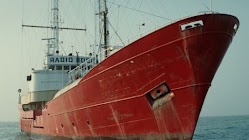
The BBC had a broadcasting monopoly in the United Kingdom. Private radio stations weren't allowed to broadcast. This led to the creation of pirate radio stations. They anchored boats in international waters, just outside of the British territorial waters, and broadcast pop music 24 hours a day. It's estimated that more than half of the British population, mostly younger people, listened to pirate radio stations regularly. This was a thorn in the eye to the BBC and the UK government in general, so they spent years trying to find ways to make them illegal.

The most popular pirate radio station was Radio Caroline. The radio station in the film, Radio Rock, is clearly based on Radio Caroline. Several of the film's DJs are clearly based on famous Radio Caroline DJs like Tony Blackburn, Terry Wogan and Emperor Rosco. Maybe they all are. I really must listen to the director's commentary to hear what Richard Curtis has to say about the cast.

"The Boat that Rocked" isn't just a film about the 1960's, it's a film in the style of the 1960's comedies. Rather than telling a single story, there are multiple situations taking place side by side. Government ministers are struggling to make new laws. The nephew of the boat owner is trying to find out who his father is. A DJ is heartbroken when a woman marries him only to get close to another DJ. Girls visit the boat every second Saturday to have sex with the DJs, because no women are allowed to live on the boat. The only exception to this rule is Felicity, the ship's cook. She's a lesbian, which means that she's not a real woman. The others on the ship call her lesbionic. Nice word. I'd use it myself, if I were sure that women didn't find it offensive


This is a film that desperately needs a Director's Cut. The Blu-ray contains 44 minutes of deleted scenes that were only removed because the film was too long. That's tragic. Unfortunately, the film was a financial failure, so it's unlikely that the studios would approve a Director's Cut. Maybe the topic is too obscure for cinema audiences outside of the UK. It's worth watching by anyone who loves music, 1960's or later.

Success Rate:  - 1.4

Order from Amazon.com
Order from Amazon.co.uk
Order from Amazon.de

Wednesday, 23 August 2017

The Boat that Rocked (4 Stars)


I've watched this film a few times, but I've missed out until now. My Blu-ray disc has 44 minutes of deleted scenes. They're not like the fuzzy raw footage that we see on other discs, they're at a reasonable 540p resolution. As the director Richard Curtis explains, they were all scenes that should have been in the film, and it broke his heart to remove them, but it was a painful necessity, because nobody wants to see a three-hour film about a big boat.

There are 14 deleted scenes (actually 13 deleted scenes and one extended scene), and I have to say that I enjoyed all of them. I regret that they're not in the film itself. Isn't there a demand for a director's cut? I would buy it. If anything, Rhys Ifans suffers most from the cuts. His character is built up in the deleted scenes better than in the film itself.

The film is set in 1966-1967. It's about a fictional pirate radio station broadcasting from the North Sea, but it's based heavily on Radio Caroline. Some of the disc jockeys are recognisable to me, or at least I can see who they are based on, whatever their names in the film are. This is a film where I need to listen to the director's commentary. I only remember the big disc jockeys from the 1960's, like Emperor Rosco, John Peel, Terry Wogan and Tony Blackburn. In the commentary the director might state who the others are based on.

The film has several plots running side by side. They fit together very well. There's the government opposition to pirate radio stations, the coming of age of Carl, the 17-year-old godson of the station's owner, and the friendly rivalry between the top DJ's. Other smaller plots are found only in the deleted scenes.


The film is memorable for the meeting of Nick Frost and Gemma Arterton. It's love at first sight.


Gemma can't keep her hands off him. Lucky Nick.


Maybe he has something I don't. This photo might give me a clue.


I lived through the age of pirate radio. I owned a small radio, smaller than the one in this photo but probably better quality, that I kept next to my bed. I was less interested in the actual pirate radio stations. I spent more time listening to Radio Luxembourg, which provided a similar selection of pop songs, also presented by English DJ's like Noel Edmonds, Kenny Everett and Johnny Walker. Incidentally, I consider Noel Edmonds to have been a brilliant DJ. It's sad that he's a television host now. He should have remained with what he did best.

More than anything, the film is about the music. Most of the musical selection is accurate, the songs being picked from 1961 to 1967. A couple of later songs have slipped in, such as "Fire" (1968) and "Won't get fooled again" (1971), but they still fit the style of the two years when the film takes place. During the final credits more recent songs are played, as examples of songs that are influenced by the pop music of the 1960's.

Here is the full list of the songs used in the film:


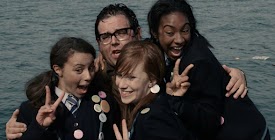
At the end of the film Gemma Arterton has left, but Nick Frost finds himself an armful of schoolgirls to comfort him. I hope they're all over 16, for his sake. Nowadays the law frowns on the antics of radio DJ's.


Tom Wisdom finds himself 33 girls to play with. Is he crazy? No man could survive a night like that. Come to think of it, I wouldn't even survive Nick's three schoolgirls.


This is a highly entertaining film. It doesn't tell all the history of what happened in these fateful years. That's not its purpose. If you don't already know the story of pirate radio in the 1960's I advise that you read about it. Pirate radios actually operated from 1964 to 1990, but they were less important after the founding of BBC Radio One on 30th September 1967. For all its faults, Radio One gave the public what it wanted. "If you can't beat them, buy them". The top DJ's of the pirate radio stations were hired by the BBC, and the radio listeners followed them.

Order from Amazon.com
Order from Amazon.co.uk
Order from Amazon.de

Thursday, 25 September 2014

A Most Wanted Man (4 Stars)


Ever since this film was announced a friend of mine who is a big John le Carré fan was telling me that I really must watch it. And then another friend who's an Anton Corbijn fan told me I should watch it. But I didn't need the encouragement of either of them. The film stars Philip Seymour Hoffman in the leading role, so I would have gone to see it whoever had written or directed it.

I have never read any of John le Carré's books, but I know a little about him. He is a British author who writes books about espionage. He had the advantage of working for the British intelligence services, MI5 and MI6, which gave him insight into the way espionage works. This film is very different to spy thrillers such as the James Bond films. We don't have spectacular car chases and agents leaping from helicopters while firing their guns at people on the ground. This is a very sober story of the way secret agents really live and work. It's not all excitement being a spy, it's about investigation, paperwork and negotiations with the police and other agencies. Being a spy is a 9 to 5 job, and this film gives an insight into the job for anyone who is considering it as a career.

Philip Seymour Hoffman plays Günther Bachmann, the head of a small counter-terrorism unit based in Hamburg. A Chechnyan terrorist who is being sought by the Russian authorities enters Germany illegally. The German police want to arrest him immediately, but Bachmann persuades them to let him remain free, under observation, so that he can be used to gain evidence that a Moslem philanthropist, Dr. Faisal Abdullah, is secretly financing Al Qaeda.

Apart from Philip Seymour Hoffman and Willem Dafoe, who plays a banker, the film contains the top German actors Daniel Brühl and Nina Hoss. The singer Herbert Grönemeyer has a small part in the film, as well as composing the film's music.

It's interesting that this is the second film I've seen in the cinema in two weeks which includes an excerpt from "The Mussolini", a 1981 hit by DAF. In "A Most Wanted Man" it's being played in a club, in "The Guest" we hear Anna Petersen listening to it in her room. DAF are a group who achieved great success in Germany, but are hardly known in other countries. It would be good to revive interest in them.

Click here for the music video of "The Mussolini".

Saturday, 16 August 2014

The Master (4 Stars)


Freddie Quell (Joaquin Phoenix) is an American sailor in the Second World War. When the war is over he is traumatised by his experiences and is unable to settle down. After doing a series of jobs he stows away in a yacht one night. When he wakes up the yacht is at sea, and he meets the yacht's owner, Lancaster Dodd (Philip Seymour Hoffman). Far from being angry, Lancaster offers Freddie work on the yacht, and he also invites him to his daughter's wedding. Freddie soon discovers that Lancaster is the leader of a cult called The Cause, and the other passengers on the yacht call him Master.

Freddie becomes a close friend of Lancaster and joins the cult, even though the other members warn Lancaster against him. They think that Freddie is unwilling to get over his alcohol addiction and become a better man. Freddie also has problems with aggression. Whenever anyone insults Lancaster or The Cause Freddie beats him up. Lancaster says that he doesn't approve of violence, but makes no attempt to stop Freddie doing it again.

The fictional cult, The Cause, is obviously based on Scientology. In The Cause people advance through psychoanalysis rather than meditation. It is taught that perfection can only be attained by remembering and dealing with things that happened in past lives. Apart from the similarity in the teachings, the film mirrors conflicts that Scientology's founder L. Ron Hubbard had with his son and other family members.

The film created controversy as soon as it was announced. The similarities to Scientology were enough to make many cult members angry. Legal proceedings were avoided by never claiming the film was about Scientology, even though everyone knew it was. Apart from this, the film isn't directly about the cult; the central character is Freddie Quell, and it follows his spiritual journey, while The Cause and its members remain in the background, sometimes helping, sometimes hindering him.

The powerful performances by Joaquin Phoenix and Philip Seymour Hoffman won them Oscar nominations. The only thing I would fault is that the film has no resolution. Freddie drifts into The Cause, remains a while and drifts back out with almost nothing to show for it. He hasn't become a better man. On the other hand, I'm sure that this was intentional. Other films by Paul Thomas Anderson, which he both writes and directs, have the same style. One of the things that screenwriters learn is that the characters in their scripts should follow arcs. They should start the film as one person and end as another. In a typical character arc a person begins either as weak or morally objectionable, and then the film presents challenges, at the end of which the person is stronger or a better person. This might be good storytelling, but is it the way real life works? Not necessarily. There's nothing wrong with experimental films that do without character arcs, but to me personally I feel that something is lacking.

Sunday, 10 August 2014

Magnolia (4 Stars)


Things go round and round.

This is a film that I find it very difficult to write about. It tells several unrelated stories, only connected by the fact that they all take place on the same day, and some of the people know each other. A recurring theme in the stories is the alienation between children and their parents. And then there are the frogs falling from the sky.

It's a fascinating film that kept me glued to the screen from beginning to end. But when it finished I had an empty feeling. I was expecting the stories to be somehow linked together in a final scene, but they weren't. That was the point. Things happen side by side every day. We don't live in a well-scripted cinematic universe. When I leave home in the morning I say hello to my neighbours. It could be that several of us have intense personal dramas before we go to bed in the evening. And yet the only connection between these dramas was a simple greeting in the morning.

Tuesday, 4 February 2014

Synecdoche, NY (5 Stars)

Cotard's syndrome is a mental disorder in which people hold a delusional belief that they are dead, do not exist, or are decaying. While this does not necessarily lead to schizophrenia, such people are detached from the world and have strong fantasies which they use to replace reality.


This is one of the best films ever made. The combination of Charlie Kaufman's brilliant story and the incredible acting by Philip Seymour Hoffman make it the perfect film. It's difficult to believe that it flopped at the box office. It cost $20 million to make and only earned $4 million. Roger Ebert called it the best film of the decade, and many other film critics said it was the best film of 2008. So what went wrong?

Maybe the film is just too complex for the average popcorn-munching movie-goer. The following review contains some spoilers, but not too many to prevent you enjoying the film after reading it. Make your own mind up whether you want to carry on reading after the picture below.


Philip Seymour Hoffman plays Caden Cotard, a New York playwright who thinks he's dying. He is convinced that he has cancer, that he's going blind and that he's having epileptic fits. The first time I watched the film I believed he really was ill, since we see blood in his stool, but after seeing it again I realised he was imagining it, he's only a malade imaginaire. Ironically, at the end of the film he's one of the last people left alive in a city of corpses.

Caden's wife Adele is a world famous artist who paints miniature pictures that can only be seen through a magnifying glass. At the beginning of the film she leaves Caden and goes to live in Berlin with their 4-year-old daughter, Olive. Shortly after this Caden's skills as a playwright are acknowledged by him being awarded a grant which is big enough for him to make the most extravagant play ever performed. He buys an enormous warehouse in which he rebuilds New York and gathers a cast around himself to make a play about his own life. Each day, as things happen to him, he adds new events to the play. After 17 years of rehearsing the cast members complain that he's still not finished and ready to invite an audience, but he asks them to persevere. After that the film doesn't give any details about the passing of time, but my guess is that he works on the play for at least 40 years.

During this time Caden has an affair with Hazel, a box office girl who he later promotes to producer. He gets married again to Claire, an actress. These are events featured in his play, so he has to hire actors to play himself and Hazel, but he asks Claire to play herself, much to her distress when the other Caden is touching her. The actor playing Caden makes a play about his own life, so he builds a warehouse inside the warehouse to use for a large scale play. After about 20 years Adele returns to New York. Caden goes to visit her apartment, but she isn't at home. A neighbour mistakes him for the cleaning lady, Ellen, and gives him the key. Over the next months (or is it years?) he visits Adele's apartment every time she goes out and cleans it for her. This too is featured in his play, although he uses a real woman to play Ellen. When the actor playing Caden commits suicide, Caden decides to give up directing the play and become the actor playing himself. The actress who had been playing Ellen takes his place directing the play, and she orders all of his actions, both inside the play and in the real world.

Whooo! Is that confusing? Yes. Is it brilliant? Yes.

Caden and Caden and Hazel and Hazel

Monday, 3 February 2014

The Boat that Rocked (4 Stars)

It's 1966. The greatest era for British rock & roll. But BBC radio plays less than 45 minutes of pop music a day.

Fortunately pirate radio stations are anchored in the North Sea. They play rock and pop 24 hours a day. And 25 million people, half the population of Britain, listen to the pirates every single day.


The 1960's were a weird time for music in Great Britain. A new music had emerged, independent of what was happening in the USA. Most notable were the Beatles and the Rolling Stones, but there were also underground bands playing blues-influenced music such as Cream and the Yardbirds. But if you sat and listened to the radio at the time you wouldn't know that it existed. The BBC, which had a monopoly of legal radio stations in Britain, only played classical music, easy listening or pop music acceptable to grannies (Tom Jones, Lonnie Donigan, Paul Anka).

The first and most famous pirate radio station was Radio Caroline, which began broadcasting in 1964. It broadcast music from a ship which was moored in international waters, so it didn't come under British law. Over the next few years many other ships copied the pattern. This was a great annoyance to the BBC, when they realised that half of the population listened to the pirates. The only way the BBC could survive was by changing to meet the challenge. On September 30th 1967 the BBC started a new radio station,  which they called Radio One, that played pop music 24 hours a day. More than half of the DJs hired for the new station were pirate DJs, lured away from the cold north sea waters by big salaries. The most famous of the ex-pirate DJs now working for the BBC were Tony Blackburn and John Peel.

Radio One was greeted with great optimism, but it didn't mean the death of pirate radio. An official top 40 playlist was imposed for all weekday daytime broadcasts, so during the day only the current hits were played. This secured a large audience, but it wasn't enough to make everyone happy. To make things worse, there were soon holes in the Radio One broadcasts, mainly in the mid afternoon, when there were no Radio One broadcasts, supposedly because there was no interest in pop music at those times. The holes were filled by broadcasts from one of the BBC's other stations, Radio Two, which played easy listening and big band music. At these times the pop fans had to turn their dials back to the pirate stations.

I admit that I watched "The Boat that Rocked" today as a tribute to Philip Seymour Hoffman, who died from a drug overdose yesterday. In the film he plays a DJ called The Count, presumably based on Radio Caroline's Emperor Rosko. This is a terrific film with a great cast of actors, but the ones who stand out are Philip Seymour Hoffman and Rhys Ifans. I won't say anything about the film here, except that it takes place in 1966. Watch it! You won't regret it.

P.S. For some reason the film has been renamed "Pirate Radio" in America.

Philp and Rhys, friends forever

Rock and roll will never die!

Sunday, 2 February 2014

R.I.P. Philip Seymour Hoffman

Actors, especially great actors, enjoy a privilege denied to the rest of us. In their films they will be remembered forever.

Philip Seymour Hoffman
July 23, 1967 – February 2, 2014

Sunday, 1 April 2012

Before the Devil knows you're dead (4½ Stars)


It's been over two weeks since I watched any films. I've been catching up on some of my favorite television series on DVD. Sure, they were good. I've been watching high quality television like "Dexter", "Star Trek" and "La Femme Nikita". And yet there's nothing quite like a film. There's a big difference between the rambling character development of a television series and the self-contained unit of a film. Both have their qualities. I enjoy both, depending on my mood. And today I watched a great film.

It's the first time I've watched "Before the Devil knows you're dead". The film was made in 2007, but I only heard about it recently, when a friend strongly recommended it to me. I wasn't disappointed. Well, I admit that the first 15 minutes confused me. It starts with a couple having sex on their wedding night. Then it jumps to a robbery a few years later. From there on the scenes jump backwards and forwards through time, but by then I had figured out what's happening.

My biggest complaint about the film is the seemingly random title. It's the second half of an old Irish blessing, "May you be in Heaven half an hour before the Devil knows you're dead". This is what's shown in the film. Andy is shown having a moment of pure bliss on his wedding night in Brazil. From that time on he drops deeper and deeper into suffering. All the while he dreams of returning to Brazil, but as he progresses his dreams become less and less possible.

Andy is a successful businessman, the head of the finance department of a big company. His younger brother Hank works for the same company doing maintenance work. Although it's not stated we can assume that Andy has used his influence to get his failure of a brother a job. He deeply cares for his baby brother. But Andy has problems. He's become a drug addict, and he's stealing company funds to pay for his habit. Although he loves his wife their sex life has become dull, and he thinks he can solve all his problems by going back to live in Brazil. And so he devises the perfect crime. He plans to rob the small jewellery store owned by his parents. He expects no trouble, but his mother is shot to death. From this point his life spirals downhill.

This was the last film made by director Sidney Lumet before his death. I confess that I'd never heard of him, and I was surprised to hear in the interviews that cast and crew members were calling him "the best director who has ever lived". Just an opinion, of course, but this film is certainly a masterpiece. Lumet insists (in the interviews included on the DVD) that the film isn't a thriller, it's a melodrama. For the leading roles he picked actors who have experience of performing in theatres. He was aiming for the atmosphere of a play. There was a lengthy period of rehearsals in which he allowed the actors to bring their own feelings and emotions into the story. Rather than making requirements of them he asked them to "act naturally", as they really would if they lived through the events of the film. After this the filming was done in a relatively short period, as if it were a live theatre performance. The results are impressive. And I understand Lumet's point. The film isn't a thriller. It focuses on the emotions and interpersonal relationships of the family. It's a character study with depths that make it necessary to watch the film again and again.

Click here to view the trailer.

Friday, 19 November 2010

Red Dragon (4½ Stars)


A thrilling film from beginning to end. My only criticism is that having been filmed later it assumes that the viewer has already seen "Silence of the Lambs". This is another film that Dino De Laurentiis should be remembered for.