Showing posts with label Bill Nighy. Show all posts

Monday, 30 December 2024

World's End (5 Stars)


Simon Pegg and Nick Frost play two old friends who haven't seen each other for 20 years. They reunite to do a pub crawl in their former home town of Newton Haven. Twelve pubs, starting at "The First Post" and ending at "The World's End". Very appropriate names. But what are they staring at?


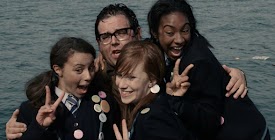
Schoolgirls! There's something delightfully sexy about girls in school uniforms, and clever women know how to take advantage of it, even in later years.


As it turns out, the schoolgirls aren't human, but even aliens know how to drive men crazy by dressing in school uniforms.


I would have surrendered to the alien schoolgirls, but the two heroes resist them and fight them to the death. As a result, society breaks down and all that there is to remind them of the past is Cornetto wrappers. There must be a moral in there somewhere.

Success Rate:  + 0.3

Order from Amazon.com
Order from Amazon.co.uk
Order from Amazon.de

Hot Fuzz (5 Stars)


Here they are again, Simon Pegg and Nick Frost, the greatest comedy duo of the 21st Century. The only others who come close are Dwayne Johnson and Kevin Hart. In this film Simon Pegg (on the right, in case you didn't know) plays Nicholas Angel, a police officer who's been transferred from London to Sandford in Gloucestershire. The London police force didn't want him because he was too efficient and showed everyone else up. Nick Frost (on the left) plays Danny Butterman, a Sandford police officer who joined the police force because his father told him to do it.

The biggest crimes in Sandford are people cutting their neighbours' hedges. There hasn't been a murder in the village for years, but Nicholas soon discovers why. Whenever someone is killed the coroner declares it an accidental death.


Nicholas is all business. He refuses to eat Black Forest Gateau at work.


But he's willing to eat a Cornetto on duty. It's not a problem as long as he isn't driving.


In 2006 Olivia Colman was still unknown. What a cute smile!

"Hot Fuzz" takes a while to get going, but once it starts it's an amazing film.

Success Rate:  + 4.7

Order from Amazon.com
Order from Amazon.co.uk
Order from Amazon.de

Sunday, 29 December 2024

Shaun of the Dead (4 Stars)


Oh wait a minute! That's the wrong film! Let's start again!


I think I got the right Shaun this time. His white shirt confused me, but he's definitely not a sheep. Or is he? He walks in a daze through his daily life, not noticing that he's in the middle of a zombie apocalypse.


As long as the shops are still open and he can buy Cornetto ice cream, why should he bother about zombies walking the streets? It might look weird that he's carrying the Cornetto in his mouth, but he needs both hands to open his Coca Cola can.


Shaun doesn't get serious until he finds a zombie in his back garden. Together with his flatmate Ed they finish her off with whatever weapons they can find.


Back in the house they look at one another in shock. Is it because they've just killed their first zombie, or because Ed wants to know why his Cornetto wrapper is wet?

Simon Pegg and Nick Frost are both great comedians in their own right, but as a team they're unbeatable. Laurel and Hardy, Bud Spencer and Terence Hill, and now Simon Pegg and Nick Frost. They should make more films together.

Success Rate:  + 4.5

Order from Amazon.com
Order from Amazon.co.uk
Order from Amazon.de

Thursday, 29 July 2021

The Boat that Rocked (4 Stars)


Bill Nighy, Philip Seymour Hoffman, Nick Frost and Rhys Ifans walk the plank? Say it ain't so!

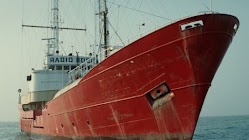
This is a cute little comedy that amuses me every time I watch it. It's not just the excellent actors, including a small appearance by Gemma Arterton. It's the whole 1960's atmosphere. Pirate radio ships were a part of British culture. They were a phenomenon unique to the UK, so I need to explain what they were to my readers from other countries. In the early 1960's British radio broadcasting was in a state of chaos. It was a time of musical revolution, sparked by groups like the Beatles and the Rolling Stones, but the BBC never played their music. In the absence of the Internet, people who weren't hip knew that a group called the Rolling Stones existed, but they'd never heard their music.

The BBC had a broadcasting monopoly in the United Kingdom. Private radio stations weren't allowed to broadcast. This led to the creation of pirate radio stations. They anchored boats in international waters, just outside of the British territorial waters, and broadcast pop music 24 hours a day. It's estimated that more than half of the British population, mostly younger people, listened to pirate radio stations regularly. This was a thorn in the eye to the BBC and the UK government in general, so they spent years trying to find ways to make them illegal.

The most popular pirate radio station was Radio Caroline. The radio station in the film, Radio Rock, is clearly based on Radio Caroline. Several of the film's DJs are clearly based on famous Radio Caroline DJs like Tony Blackburn, Terry Wogan and Emperor Rosco. Maybe they all are. I really must listen to the director's commentary to hear what Richard Curtis has to say about the cast.

"The Boat that Rocked" isn't just a film about the 1960's, it's a film in the style of the 1960's comedies. Rather than telling a single story, there are multiple situations taking place side by side. Government ministers are struggling to make new laws. The nephew of the boat owner is trying to find out who his father is. A DJ is heartbroken when a woman marries him only to get close to another DJ. Girls visit the boat every second Saturday to have sex with the DJs, because no women are allowed to live on the boat. The only exception to this rule is Felicity, the ship's cook. She's a lesbian, which means that she's not a real woman. The others on the ship call her lesbionic. Nice word. I'd use it myself, if I were sure that women didn't find it offensive


This is a film that desperately needs a Director's Cut. The Blu-ray contains 44 minutes of deleted scenes that were only removed because the film was too long. That's tragic. Unfortunately, the film was a financial failure, so it's unlikely that the studios would approve a Director's Cut. Maybe the topic is too obscure for cinema audiences outside of the UK. It's worth watching by anyone who loves music, 1960's or later.

Success Rate:  - 1.4

Order from Amazon.com
Order from Amazon.co.uk
Order from Amazon.de

Monday, 23 November 2020

Their Finest (4 Stars)


This is a charming tale about a film crew making a propaganda film in early 1941. The central character is the screenwriter, Catrin Cole, played by Gemma Arterton. She was a strong woman fighting to establish herself in a man's world.

Click here to read my full review. I'm not feeling motivated to write a lot while the new Blogger interface is full of bugs.

Success Rate:  - 0.9

Order from Amazon.com
Order from Amazon.co.uk
Order from Amazon.de

Friday, 12 October 2018

Their Finest (4½ Stars)


In summer 2017 two films were shown in the cinemas about the battle of Dunkirk. This is the better of the two. To be precise, "Their Finest" is a film about a film about Dunkirk, but it's still better than Christopher Nolan's effort. It's less pretentious, it's more emotional and it has a strong feminist message.


The film within a film is called "The Nancy Starling". It's about twin sisters, Rose and Lily, who sail to Dunkirk with their drunken father to rescue Rose's boyfriend Johnny. At the beach they don't just pick up Johnny, they take ten soldiers and an American reporter on board, the maximum their boat can hold. The boat can't sail home because a rope is tangled in its propeller. Both Johnny and the girls' father are killed by aircraft fire while trying to free the propeller. Rose is a brave English girl and doesn't let her sorrow slow her down. She dives below water and cuts the propeller free.


The film itself is about the struggles of the screenwriter Catrin Cole to make "The Nancy Starling" the film she wants it to be. She's forced to make compromises. In the original script the two sisters left the harbour without their father because they wanted to rescue British soldiers. Johnny had to be added because Catrin was told that no women would be selfless enough to risk their lives for complete strangers. The father had to go along because it was considered unrealistic for women to sail a boat by themselves; they needed a man, even if he was a drunk. To put it in other words, a drunk man is a better captain than a sober woman.

There are many scenes in the film that made me laugh because of the ridiculous male prejudices of the 1940's. I shouldn't laugh. These attitudes might seem like a joke to me 75 years later, but those were the attitudes that women have had to endure for centuries. The women of the 1940's had nothing to laugh about, they had to suffer in silence.

This is an excellent film that I'm sure I shall watch again many times in the future.

Success Rate:  - 0.9

Order from Amazon.com
Order from Amazon.co.uk
Order from Amazon.de

Sunday, 26 August 2018

World's End (5 Stars)


After watching "Christopher Robin" yesterday, I thought it would be a good idea to watch another film about not growing up. Whereas "Christopher Robin" is about never being too old to dream, "The World's End" is about never being too old to go wild and have a good time.

Gary King (Simon Pegg) grew up in the sleepy little town of Newton Haven. When he was 18 he went on a pub crawl with his four best friends. The intention was to drink a pint of beer in each of the town's 12 pubs, from the First Post to the World's End. (Click here for a gallery of the pub signs in order). The boys never finished. By the ninth pub they were too drunk to continue, but Gary considered it the best day of his life.

School was over, and Newton Haven isn't a place people stay if they don't have to. They moved away. They moved on.


Peter Page (Eddie Marsan) has become a self-employed car salesman.


Steven Prince (Paddy Considine) owns a building company.


Oliver Chamberlain (Martin Freeman) is an estate agent.


Andrew Knight (Nick Frost) is a corporate lawyer.


The other four have successful careers, but what about Gary? We're never told what he's done with his life for the last 20 years, but the suggestion is that it's nothing. Even if it was something, Gary's life has amounted to nothing. After 20 years he's still the same person he was when he left Newton Haven. He drives the same car, he listens to the same cassette tape (made for him by Steven), and he still wears a black leather jacket and a Sisters of Mercy T-shirt.

Gary King looks cool while the others look boring. They've adapted to society as they've grown older. Gary is still 18 in his heart.

More than anything else, Gary wants to regain the magic of his youth. He wants to repeat the legendary pub crawl, but this time he wants to succeed. His former friends are reluctant to relive this day, but he persuades them. After all, he's the King, while the others are only the Prince, the Chamberlain, the Knight and the Page. Gary has a charismatic power that the four businessmen don't.


It's not just charisma. Gary has a strength of character that the others lack. When they discover that Newton Haven is the site of an alien invasion, Gary is the only one who can save the world. However, that's only his second priority. The most important thing for Gary is to finish the pub crawl.

I can relate to Gary, to a certain extent. As a teenager I didn't live a life as wild as his, but I certainly lived an eccentric life. I promised I would never let myself grow old. I kept my promise for a few years. Then I got married, and it was hard to stay a teenager at heart when I had a wife and children. Like the four friends, I became a businessman. I advanced in my career and became the development leader of a small electronics company, responsible for 30 employees. Then things fell apart. First my marriage broke down, then my career, then my health. I considered it a tragedy at first, but then I came to my senses. Was it all such a bad thing? I needed to be knocked down to remind me that I'd broken the promise to myself. I'd let myself grow old, but it was now time to return to my youth. Not 18, I like to think of myself as a 16-year-old, or even younger. When I was 14 I had a naive attitude that I wish I'd never lost.

It's not about drinking. When I was young I drank a lot less alcohol that I did in my 30's. I drank almost no alcohol at all until I left university, although I did have a weird experience when I was 18. I was on holiday in Neuengeseke, Germany with my sister Shirley. In the afternoon we went to a Schützenfest (just a beer tent, a typical German excuse for drinking). I drank seven beers, only 300 ml glasses, but that was still a lot for me. Later in the evening we went to a smaller party. My friend Ulrich Goltsche challenged me to a drinking contest. Which one of us could drink the most shots? I accepted the challenge. We were drinking shots of potent German schnapps. The drinks kept on coming. Everyone was cheering when I downed each glass. After 18 glasses I saw Shirley arguing and punching people. I asked what was wrong. She told me that the drinking contest was a fake. They just wanted to get me drunk. I was drinking schnapps, but Ulrich was only drinking water. Ulrich admitted it was true. I was annoyed. I drank the 19th glass that had already been set in front of me, and I began to run. The others tried to catch me, but I was too fast. I ran and I ran. I hardly knew the area, but there were street signs. It was almost pitch black, so I had to stare closely at the signs and feel them to make out what they said. It was at least two miles, but miraculously I found my way back to the house in Neuengeseke.

I don't know how I did it. I was intoxicated, but I wasn't too drunk to get home. I've never drunk so much in one day since then. When I was in my 30's I sometimes drank two liters of wine, but never 19 shots. I stopped drinking while I was in America, and when I started drinking again a few years later my tolerance to alcohol had lessened. I can't drink that much now. Half a liter of wine is comfortable, and one liter is my limit. I'm not the drinker I used to be.

Not that I really want to be a big drinker. I don't drink often nowadays, and when I do drink it's to lessen my inhibitions and reach a golden moment when everything in the world makes sense. If I can reach this point without spending a lot of money I'm happy.

Unlike Gary, I've never saved the world. Not yet, anyway.

Order from Amazon.com
Order from Amazon.co.uk
Order from Amazon.de

Wednesday, 23 August 2017

The Boat that Rocked (4 Stars)


I've watched this film a few times, but I've missed out until now. My Blu-ray disc has 44 minutes of deleted scenes. They're not like the fuzzy raw footage that we see on other discs, they're at a reasonable 540p resolution. As the director Richard Curtis explains, they were all scenes that should have been in the film, and it broke his heart to remove them, but it was a painful necessity, because nobody wants to see a three-hour film about a big boat.

There are 14 deleted scenes (actually 13 deleted scenes and one extended scene), and I have to say that I enjoyed all of them. I regret that they're not in the film itself. Isn't there a demand for a director's cut? I would buy it. If anything, Rhys Ifans suffers most from the cuts. His character is built up in the deleted scenes better than in the film itself.

The film is set in 1966-1967. It's about a fictional pirate radio station broadcasting from the North Sea, but it's based heavily on Radio Caroline. Some of the disc jockeys are recognisable to me, or at least I can see who they are based on, whatever their names in the film are. This is a film where I need to listen to the director's commentary. I only remember the big disc jockeys from the 1960's, like Emperor Rosco, John Peel, Terry Wogan and Tony Blackburn. In the commentary the director might state who the others are based on.

The film has several plots running side by side. They fit together very well. There's the government opposition to pirate radio stations, the coming of age of Carl, the 17-year-old godson of the station's owner, and the friendly rivalry between the top DJ's. Other smaller plots are found only in the deleted scenes.


The film is memorable for the meeting of Nick Frost and Gemma Arterton. It's love at first sight.


Gemma can't keep her hands off him. Lucky Nick.


Maybe he has something I don't. This photo might give me a clue.


I lived through the age of pirate radio. I owned a small radio, smaller than the one in this photo but probably better quality, that I kept next to my bed. I was less interested in the actual pirate radio stations. I spent more time listening to Radio Luxembourg, which provided a similar selection of pop songs, also presented by English DJ's like Noel Edmonds, Kenny Everett and Johnny Walker. Incidentally, I consider Noel Edmonds to have been a brilliant DJ. It's sad that he's a television host now. He should have remained with what he did best.

More than anything, the film is about the music. Most of the musical selection is accurate, the songs being picked from 1961 to 1967. A couple of later songs have slipped in, such as "Fire" (1968) and "Won't get fooled again" (1971), but they still fit the style of the two years when the film takes place. During the final credits more recent songs are played, as examples of songs that are influenced by the pop music of the 1960's.

Here is the full list of the songs used in the film:


At the end of the film Gemma Arterton has left, but Nick Frost finds himself an armful of schoolgirls to comfort him. I hope they're all over 16, for his sake. Nowadays the law frowns on the antics of radio DJ's.


Tom Wisdom finds himself 33 girls to play with. Is he crazy? No man could survive a night like that. Come to think of it, I wouldn't even survive Nick's three schoolgirls.


This is a highly entertaining film. It doesn't tell all the history of what happened in these fateful years. That's not its purpose. If you don't already know the story of pirate radio in the 1960's I advise that you read about it. Pirate radios actually operated from 1964 to 1990, but they were less important after the founding of BBC Radio One on 30th September 1967. For all its faults, Radio One gave the public what it wanted. "If you can't beat them, buy them". The top DJ's of the pirate radio stations were hired by the BBC, and the radio listeners followed them.

Order from Amazon.com
Order from Amazon.co.uk
Order from Amazon.de

Monday, 10 July 2017

Their Finest (4½ Stars)


If you say that nobody likes war you're wrong. The film industry loves war. If there had never been any wars thousands of films would never have been made. There have been wars for hundreds of years, and several large wars in the last century, but the war most commonly featured in films is the Second World War. Many films are true stories, but there have been even more fictional stories set during the war. WW2 is a fascinating backdrop for dramatic productions, something that people can relate to even now, 72 years since the end of the war.

Hollywood was fast to cash in on the war. As early as October 1939, one month after the beginning of the war, "Hitler: Beast of Berlin" was made. Interestingly, the film was banned in America for being too inflammatory, the 1930's euphemism for hate speech. At the time America wanted to remain neutral, so it was considered inappropriate to insult the German leader. A year later American sentiment was turning against Germany, so "The Great Dictator" could be made, but even then caution was taken. The dictator's name was Adomine Hynkel and his country was called Tomania, even though it was plainly obvious, nudge nudge wink wink, who was really meant.

It was easy for America to make films about the war while it was ongoing, even after it entered the war in 1941, because it didn't affect their own country. The Hollywood studios weren't being bombed, so it was business as usual. From 1942 to 1945 America made 150 films about the war. Business was booming. When the war ended there was a slump, and only 12 war films were made from 1946 to 1949. Without an active war going on in Europe the American public lost interest.

A relatively small number of films were still being made in England, some about the war, some about other topics. England was under constant attack from 1940 onwards, so it was difficult for the film industry to continue. It wasn't just a matter of the studios being bombed; many actors left to fight in the war.

This sets the stage for "Their Finest". It begins in 1940 in London. The Ministry of Information is responsible for making propaganda films. Most of them are short films which are shown in cinemas between the B-Film and the main feature. They are intended to motivate those not fighting in the war, mostly women, to do something for the war effort, such as working in factories making bullets. The films are so ridiculous that the audiences laugh at them. The Ministry of Information finally comes to the conclusion that if the propaganda films are targeting women a woman should be hired to write them.


Catrin Cole (Gemma Arterton) is hired on the basis of political cartoons she has drawn. The sexism of the time is so blatant that it's hilarious. "The wages for this job are three pounds ten shillings a week. We can't pay you that much because you're a woman, so you'll get two pounds". After making a few short films Catrin is given a bigger project. The newspapers have reported about two young women, Rose and Lily Starling, who rescued 20 soldiers from Dunkirk in their father's boat. This will be made into a full length feature film to encourage women to do more. Catrin goes to interview the sisters and finds out that the story is untrue; it was a misunderstanding by the press. Their boat broke down before it reached Dunkirk, and it was towed back by another rescue boat. Nevertheless, Catrin thinks that the story should be told as reported by the newspapers. When a propaganda film is made the truth is secondary. It's easy to accuse the propaganda of foreign totalitarian countries as lies, but England too can lie if it's considered necessary to boost public morale.

The film is supposed to show female heroism, but when the initial script is presented it's too extreme for Catrin's male bosses. The father of the two girls has to accompany them on the boat. Then it's necessary for Rose's lover Johnny to be among the soldiers rescued from Dunkirk. After all, a woman could never be heroic enough to risk her life for strangers, could she? On the return journey Johnny has to perform any essential feats of heroism, because he's a man and that's what men do. Then it's decided that the film should also be used to encourage America to join the war, so a well-known American fighter pilot who has volunteered for the Royal Air Force is asked to play a leading role, even though he lacks any acting skill. It's not Catrin's film any more.

Through a string of circumstances -- spoilers! -- Catrin manages to regain control of the film. It becomes the feminist classic that she intended. The result is a film that can motivate both women and men to do great things.


The film is carried by the brilliant performance of Gemma Arterton as Catrin. She's the best English actress who has ever lived. She can skilfully reveal her emotions by underplaying them. As a woman of the 1940's she's being suppressed by the male-dominated society. She knows what's expected of her and she conforms, but her strength is visible beneath the surface.

The film is a comedy with subtle humour. Evidently it was too subtle for the Germans in the cinema tonight. I laughed, they didn't.


Did you notice the error in the film poster that I reproduced at the beginning of this post? Whether the official flag of the United Kingdom, the Union Jack, is meant to be portrayed upright or on its side, it's incorrect. The image in the poster's background is symmetrical, but every British schoolchild knows that the flag is not symmetrical. It's not easy to draw correctly. When I was in junior school we had to practise drawing it, but art was never my strong subject. Today it's easy. I just have to copy and paste an image from the World Wide Web.