Showing posts with label Kenneth Branagh. Show all posts

Sunday, 1 October 2023

A Haunting in Venice (3 Stars)


Jump scares in a murder mystery? That's unusual, but "A Haunting in Venice" is a crossover between murder mysteries and horror films. It's based on the Agatha Christie novel "Halloween Party". This is one of the few Agatha Christie novels that hasn't been filmed before. It's because it was considered one of her weakest books. To improve it, the location of the film was set in Venice instead of London. The eerie atmosphere of the Venice canals is a definite improvement, distracting from the weakness of the plot.

Hercule Poirot has retired and is living in Venice, turning down all requests to solve murders. His friend the author Ariadne Oliver asks him to visit a seance. An opera singer wants to speak to her dead daughter to ask why she committed suicide a few months earlier. Hercule doesn't believe that it's possible to speak to the dead, so he visits the seance with the intention to uncover the medium as a fraud. But then the medium is killed, and the investigation begins.

The film has been highly praised, but I couldn't relate to it. I'm not a fan of murder mysteries. The long monologue in which the ex-detective explained what had happened and who was guilty bored me. I would have preferred a fully fledged horror film.

Friday, 21 July 2023

Oppenheimer (5 Stars)


I'll watch any film made by Christopher Nolan, despite my disappointment with his last (almost) true film, "Dunkirk". Before going to see "Oppenheimer" I was tempted to read up on Robert Oppenheimer. I'd heard his name and I knew he had something to do with the first atom bomb, but I knew nothing about his life. Eventually I decided to watch the film first and inform myself later.

Imagine my shock when the film started as a courtroom drama. Almost a courtroom drama. It's repeatedly emphasised that it wasn't a court, it was a senate committee. The difference is subtle. If found guilty, Robert Oppenheimer wouldn't be sentenced to prison, but he'd lose his security clearance and his ability to work for the government.

The film shows three phases in his life: before the Second World War, during the war and after the war. They're easy to tell apart from the cinematography, with the post war scenes being shown in black and white. A slight criticism is that I only roughly know when they happen. I would have appreciated the dates, or at least the years, being flashed on the screen.

So far I've only skimmed the Wikipedia page on Oppenheimer. It's late at night. I'll read more about him tomorrow. All I'll do is give a very brief summary of his life. It's not spoilers, because people with more knowledge than me would have known it already.

Before the war Robert Oppenheimer was an internationally renowned expert in quantum mechanics. He wasn't a Communist, but he kept an open mind, and he attended informal meetings of Communists. During the war he was made the leader of the Manhattan Project, which developed the first atomic bomb. After the war he was an adviser to the American government on the further development of atomic bombs, but his past history with the Communist party was dug up to discredit him, until he lost his security clearance and was no longer allowed as an adviser.

It's a powerful film. It's not exactly a pacifist film, although it could be interpreted that way. Oppenheimer built the bomb, and he was proud of his work, because it saved millions of lives. In 1945 America was planning to invade Japan, but every Japanese child from the age of 12 upwards had been given a rifle. It was estimated that at least nine million Japanese civilians would die in the invasion. In comparison, less than 300,000 died as a result of the bombs on Hiroshima and Nagasaki. However, in the following years Oppenheimer had a What-Have-I-Done feeling, and he tried to persuade America not to make even bigger bombs.

Despite being shown in English, the film was almost sold out in Gloria, a cinema that has two large screens. The other screen showed "Barbie", also almost sold out. This made me happy. It's Gloria's most successful day since the Corona pandemic started in 2020. Cinema isn't dead, it just needs the right films.

Thursday, 30 December 2021

Mary Shelley's Frankenstein (5 Stars)


In 1973 Todd Rundgren wrote the words "Love between the ugly is the most beautiful love of all". It's been a long time since I've listened to his album, "A Wizard, A True Star", considered by many to be his best album, but I'll never forget that song. It went through my head as I watched the final scenes of "Mary Shelley's Frankenstein" tonight.

In the past I only rated it four stars. I don't know why. It deserves more. I might have been distracted by the imperfect picture quality. The picture is fuzzy, especially in the darker scenes. It's in need of a better remastering.


Beauty is in the eye of the beholder?

In case you're interested, I wrote more about the film in my 2018 review.

Success Rate:  + 0.5

Order from Amazon.com
Order from Amazon.co.uk
Order from Amazon.de


Addendum on 31st December, 2021

I just found out that "Mary Shelley's Frankenstein" will be released on 4K disc on 29th March 2022. That will mean a new remastering. I'm excited.

Thursday, 29 July 2021

The Boat that Rocked (4 Stars)


Bill Nighy, Philip Seymour Hoffman, Nick Frost and Rhys Ifans walk the plank? Say it ain't so!

This is a cute little comedy that amuses me every time I watch it. It's not just the excellent actors, including a small appearance by Gemma Arterton. It's the whole 1960's atmosphere. Pirate radio ships were a part of British culture. They were a phenomenon unique to the UK, so I need to explain what they were to my readers from other countries. In the early 1960's British radio broadcasting was in a state of chaos. It was a time of musical revolution, sparked by groups like the Beatles and the Rolling Stones, but the BBC never played their music. In the absence of the Internet, people who weren't hip knew that a group called the Rolling Stones existed, but they'd never heard their music.

The BBC had a broadcasting monopoly in the United Kingdom. Private radio stations weren't allowed to broadcast. This led to the creation of pirate radio stations. They anchored boats in international waters, just outside of the British territorial waters, and broadcast pop music 24 hours a day. It's estimated that more than half of the British population, mostly younger people, listened to pirate radio stations regularly. This was a thorn in the eye to the BBC and the UK government in general, so they spent years trying to find ways to make them illegal.

The most popular pirate radio station was Radio Caroline. The radio station in the film, Radio Rock, is clearly based on Radio Caroline. Several of the film's DJs are clearly based on famous Radio Caroline DJs like Tony Blackburn, Terry Wogan and Emperor Rosco. Maybe they all are. I really must listen to the director's commentary to hear what Richard Curtis has to say about the cast.

"The Boat that Rocked" isn't just a film about the 1960's, it's a film in the style of the 1960's comedies. Rather than telling a single story, there are multiple situations taking place side by side. Government ministers are struggling to make new laws. The nephew of the boat owner is trying to find out who his father is. A DJ is heartbroken when a woman marries him only to get close to another DJ. Girls visit the boat every second Saturday to have sex with the DJs, because no women are allowed to live on the boat. The only exception to this rule is Felicity, the ship's cook. She's a lesbian, which means that she's not a real woman. The others on the ship call her lesbionic. Nice word. I'd use it myself, if I were sure that women didn't find it offensive


This is a film that desperately needs a Director's Cut. The Blu-ray contains 44 minutes of deleted scenes that were only removed because the film was too long. That's tragic. Unfortunately, the film was a financial failure, so it's unlikely that the studios would approve a Director's Cut. Maybe the topic is too obscure for cinema audiences outside of the UK. It's worth watching by anyone who loves music, 1960's or later.

Success Rate:  - 1.4

Order from Amazon.com
Order from Amazon.co.uk
Order from Amazon.de

Thursday, 4 March 2021

Tenet (4 Stars)


Normally I wait to buy a film on Blu-ray until the price has dropped significantly. I rarely pay more than 6 Euros for a Blu-ray, except for the Marvel films, which remain expensive longer, and even then I won't pay more than 10 Euros. In the case of "Tenet" I made an exception. I was impatient to watch it again, so I paid almost 16 Euros.

Is it worth it? That's difficult to say. It's more a matter that I wanted to understand the film better than I did after only watching it once. I think I've got it now.

To put it simply, without giving away too many spoilers: unnamed adversaries from the future want to destroy the present day world. Is that a paradox? If we all die, will they ever be born? That's a question for philosophers and quantum physicists to answer. We never see these enemies, because they have an agent on Earth at the moment who will do their dirty work for them. It's Andrei Sator, a Russian arms dealer who has received weapons from the future.

These weapons have the principle of working backwards in time. The bullets of a gun fly back into the gun. For some reason, which isn't completely logical, being hit by a reverse bullet is more dangerous than being hit by a normal bullet.

As the film progresses we see that not only bullets can be inverted to move backwards through time, people can also be inverted. Even if you can get your head around this idea, it's impossible to explain it scientifically, but it leads to spectacular fights and car chases between forward moving and backward moving objects.

A weakness in the film is that the unnamed main character, played by John David Washington, doesn't have much charisma. I found it difficult to relate to him and his motivation. Robert Pattinson is a much better actor and should have been given the main role. Nevertheless, it's a good film, but not Christopher Nolan's best.

Success Rate:  - 0.2

Order from Amazon.com
Order from Amazon.co.uk
Order from Amazon.de

Tuesday, 1 September 2020

Tenet (4 Stars)


Off to the cinema I went again. While it always used to be something of pleasure, now it's with trepidation. The Coronavirus has to be taken seriously. It would be foolish to arrange a meetup with a dozen participants. Maybe nothing would happen, but if one of us had the virus, all 12 would get it. It's a matter of risk assessment. I went to the cinema to see "Tenet" with only one friend, a member of my cinema group. Two people is a sensible maximum.


The cinema's booking algorithm has been written to allow for social distancing. As soon as seats are booked, one or several, the surrounding seats are blocked: two on each side, the seats directly in front and behind, and the seats diagonally in front and behind. Above is the actual screenshot of the cinema seating before I booked my tickets last week. I should have made another screenshot this afternoon before I went out. The cinema was sold out, with the blocked seats outnumbering the booked seats by about five to one.

I can understand people wanting to go out and have fun. Man is a social creature. There's been six months of restrictions, varying in intensity, from country to country. People are fed up with sitting at home every evening. There's only so much Netflix people can take. Now men want to meet their friends for a drink, or they want to go dancing and chat up girls. The politicians understand, probably better than me, that there's a fine balance between the dangers of Coronavirus and the dangers of civil unrest by people who rebel against the lockdowns. A lot of people are complaining that their leaders haven't done enough to protect them. A lot of people are complaining that they're doing too much. All I can say is that I wouldn't want to be doing their job.

It's not a matter of the law. It's a matter of common sense. The current German laws allow me to arrange a meetup with a dozen people. Even the cinema's booking algorithm would allow me to book 12 seats side by side in a row. I didn't do it, not because it's not allowed, but because I consider it foolish. I would feel guilty if there were an outbreak of Coronavirus in my film group. I would give myself the blame, nobody else.


Now let's get to the film itself. I don't want to say too much for fear of revealing spoilers, so I'll keep to a very general description. An unnamed spy, played by John David Washington, comes across weapons that are inverted, meaning that when fired they travel backwards in time. He goes on a mission to find the arms dealer who is receiving these weapons from the future. As the film progresses he discovers that it's not only weapons, he also has to fight against people who are moving backwards through time.

This is in many ways a typical Christopher Nolan film. It's a similar concept to his film "Memento", although that didn't have a science fiction slant to it. I'll just add two comments:

1. Throughout the film I was trying to figure out the name of John David Washington's character. I was sure I'd missed it by not paying attention. It wasn't until the credits rolled and I saw him listed as "The Protagonist" that I realised I hadn't missed anything, he hadn't been named. That was annoying.

2. I was presently surprised at how good the acting was by Robert Pattinson, who plays Neil, the Protagonist's superior officer. He has a lot more talent than I gave him credit.

This is definitely a film I want to see again. Some things weren't easy to understand on first viewing, but knowing Christopher Nolan I'm sure it all makes sense. If I lived in normal times I'd probably return to the cinema, but in the days of the Coronavirus I'll be patient and wait to buy it on Blu-ray.

Saturday, 5 January 2019

Mary Shelley's Frankenstein (4 Stars)


This is one of the reasons I could never be a professional film critic. I'm too erratic with my viewing. At the moment I have more than 60 films on my to-watch list, but I've gone back to watch "Mary Shelley's Frankenstein" after watching it less than two months ago. I should be working my way through my list. In my defence, I had a good reason. After seeing "Mary Shelley" three days ago I wanted to watch the film based on her famous novel once again.

I read the novel when I was 15. I'd already seen the two major Frankenstein films, the Universal Studios film of 1931 and Hammer Studios' "Curse of Frankenstein" (1957). I expected the novel to be similar to the films, but it was very different. Instead of being a true horror story it was sad and emotional.There was nothing to scare me, not even the occasional murders, but there was a lot to move me. I remember my friend Bryan Westley interrupting me when he saw me reading the book. He asked me "How many people has he killed so far?" He didn't get it. I hope he's read the book by now.

The film has been badly rated by critics, but unfairly so. This is the most faithful adaptation of the novel so far. It's fast-moving and dramatic. Maybe it's lacking emotionally. Even though it's a sad film it doesn't move me to tears. Maybe there will be a newer better adaptation one day. Until then, this is the best available.


Was Helena Bonham-Carter the correct choice to be cast as Victor Frankenstein's sister Elizabeth? Maybe not. She's one of my favourite actresses, but there's an air of madness about her that doesn't fit the role.

Success Rate:  + 0.5

Order from Amazon.com
Order from Amazon.co.uk
Order from Amazon.de

Saturday, 17 November 2018

Mary Shelley's Frankenstein (4 Stars)


"I have love in me the likes of which you can scarcely imagine and rage the likes of which you would not believe. If I cannot satisfy the one, I will indulge the other".

This film was released in 1994 and is often referred to simply as "Frankenstein". I prefer the full name, because it distinguishes it from the other films with the same name. There are some disputes about its quality as a film, but it's recognised as the most faithful adaptation of Mary Shelley's novel, written in 1818.

The two characters Dracula and Frankenstein are usually mentioned in the same breath by fans of the classic horror films. Universal Studios' films about the two characters were both released in the same year, 1931, "Dracula" in February and "Frankenstein" in November. If we look at the two films we can see that the film adaptations were handled very differently. "Dracula" was obviously based on Bram Stoker's 1897 novel, not a 100% accurate reproduction, but close enough for those who knew the novel to recognise the story. "Frankenstein" was different. It borrowed the idea of a creature being pieced together from dead body parts, but the story went in a completely different direction. When Hammer made a new version of "Frankenstein" in 1957, the style gothic instead of impressionist, the film was closer to the original novel, but it still borrowed many of the story deviations from Universal's film.

Summing up, there have been many attempts to faithfully tell the story of Dracula on film, with differing levels of success, but this was the first attempt to tell the story of Victor Frankenstein and his monster as Mary Shelley envisioned it.


The screenplay was written by Frank Darabont, one of my favourite directors. What does he have to say about the film?

"Frankenstein is the best script I ever wrote and the worst movie I’ve ever seen".

Anyone who reads that statement after watching the film has to shake his head in disbelief. Many people like the film greatly, and even those who dislike the film wouldn't say it's the worst film ever made. Far from it.

Frank goes on to qualify what he means, but before quoting his exact words I'll try to explain his feelings. He wrote the script. He had a dream about the film. In his mind he pictured how the finished product would look. He sold the script to the film studio, who then put it in the hands of the director, Kenneth Branagh. The director interpreted the script and gave the film a style that so greatly differed from Frank Darabont's dream that he was devastated. In his eyes it became the worst film he'd ever seen, because he was comparing it with his dream.

To continue with Frank Darabont's words:

"There’s a weird doppelganger effect when I watch the movie. It’s kind of like the movie I wrote, but not at all like the movie I wrote. It has no patience for subtlety. It has no patience for the quiet moments. It has no patience, period. It’s big and loud and blunt and rephrased by the director at every possible turn.

"Cumulatively, the effect was a totally different movie. I don’t know why Branagh needed to make this big, loud film. The material was subtle. Shelley’s book is way out there in a lot of ways, but it’s also very subtle. I don’t know why it had to be this operatic attempt at filmmaking. Shelley’s book is not operatic, it whispers at you a lot. The movie was a bad one. That was my Waterloo. That’s where I really got my ass kicked most as a screenwriter".


I understand Frank Darabont. I sympathise with him. I know what he means about Mary Shelley's novel. I read it after I'd already seen the Universal and the Hammer films several times. I was surprised by the style. The storytelling was slow and elegant. It was an emotional story that made me cry. Even when Frankenstein's monster killed people I felt sorry for him.

Let me contradict Frank Darabont. The movie isn't a bad one. It's a very good film. However, it isn't a subtle film. It's loud and brash, right from the beginning. It was never Kenneth Branagh's intention to make a subtle film. If he'd wanted to make a subtle film he wouldn't have cast actors like John Cleese and Helena Bonham Carter. Kenneth Branagh wanted to make a brash movie, and he succeeded. It only slows down in the final 15 minutes, but even then the sadness and mourning are exaggerated.

Frank Darabont says that he doesn't know why Kenneth Branagh wanted to make this "big, loud film". I'd like to venture a guess. Branagh must have been well acquainted with the old Frankenstein films. They were big and loud, especially the Universal version. I think he wanted to maintain the atmosphere of the old films while returning to the plot of the original novel. Was this the correct choice? I don't know. The film might have been better if it had retained the subtleties of Framk Darabont's dream. It might have been worse. I can't say for certain because it was never made. I don't know what Kenneth Branagh would have done with it.

What I can say with absolute certainty is that if Frank Darabont had directed the film himself it would have been perfect. I have full confidence in his abilities as a director. He would have brought his dream to the big screen and had the cinema audiences in tears.

Success Rate:  + 0.5

Order from Amazon.com
Order from Amazon.co.uk
Order from Amazon.de

Saturday, 18 November 2017

Murder on the Orient Express (2017 version) (4 Stars)


Today I went to see the new version of "Murder on the Orient Express" in the cinema, as I announced yesterday when I reviewed the original version. The new version turned out pretty much as I expected. It looks superior to the original in its cinematography, while the story is almost the same. The new version is so similar that I have to ask what the point was in remaking the film. But I suppose that's a rhetorical question. It's all about money.

One of the few changes is that two characters in the original film have been combined into one. The Scottish soldier (Colonel Arbuthnot) and the Greek doctor (Dr. Constantine) have been merged into a Black American doctor, Dr. Arbuthnot. I'm sure there's a joke in there somewhere.

The original is a pure mystery film. The new version adds a few elements of action. I can't name all the additions because that would mean giving away spoilers. One example is that in the original the train has to halt because the rails have been covered by snow in an avalanche. In the new version the train drives into the snow and the engine is derailed. There's a new chase scene when one of the suspects attempts to leave the train. Do today's audiences need more action to be able to sit through a film? I suppose they do.

One slight change that I regret in the new version is the lack of claustrophobia. In the original all the interviews by Hercule Poirot were held inside the train. In the new version he spends more time outside the train.

My summary is simple: the new film is quite good, but unnecessary from an artistic point of view.

Wednesday, 23 August 2017

The Boat that Rocked (4 Stars)


I've watched this film a few times, but I've missed out until now. My Blu-ray disc has 44 minutes of deleted scenes. They're not like the fuzzy raw footage that we see on other discs, they're at a reasonable 540p resolution. As the director Richard Curtis explains, they were all scenes that should have been in the film, and it broke his heart to remove them, but it was a painful necessity, because nobody wants to see a three-hour film about a big boat.

There are 14 deleted scenes (actually 13 deleted scenes and one extended scene), and I have to say that I enjoyed all of them. I regret that they're not in the film itself. Isn't there a demand for a director's cut? I would buy it. If anything, Rhys Ifans suffers most from the cuts. His character is built up in the deleted scenes better than in the film itself.

The film is set in 1966-1967. It's about a fictional pirate radio station broadcasting from the North Sea, but it's based heavily on Radio Caroline. Some of the disc jockeys are recognisable to me, or at least I can see who they are based on, whatever their names in the film are. This is a film where I need to listen to the director's commentary. I only remember the big disc jockeys from the 1960's, like Emperor Rosco, John Peel, Terry Wogan and Tony Blackburn. In the commentary the director might state who the others are based on.

The film has several plots running side by side. They fit together very well. There's the government opposition to pirate radio stations, the coming of age of Carl, the 17-year-old godson of the station's owner, and the friendly rivalry between the top DJ's. Other smaller plots are found only in the deleted scenes.


The film is memorable for the meeting of Nick Frost and Gemma Arterton. It's love at first sight.


Gemma can't keep her hands off him. Lucky Nick.


Maybe he has something I don't. This photo might give me a clue.


I lived through the age of pirate radio. I owned a small radio, smaller than the one in this photo but probably better quality, that I kept next to my bed. I was less interested in the actual pirate radio stations. I spent more time listening to Radio Luxembourg, which provided a similar selection of pop songs, also presented by English DJ's like Noel Edmonds, Kenny Everett and Johnny Walker. Incidentally, I consider Noel Edmonds to have been a brilliant DJ. It's sad that he's a television host now. He should have remained with what he did best.

More than anything, the film is about the music. Most of the musical selection is accurate, the songs being picked from 1961 to 1967. A couple of later songs have slipped in, such as "Fire" (1968) and "Won't get fooled again" (1971), but they still fit the style of the two years when the film takes place. During the final credits more recent songs are played, as examples of songs that are influenced by the pop music of the 1960's.

Here is the full list of the songs used in the film:


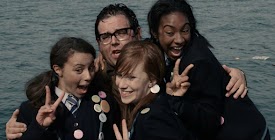
At the end of the film Gemma Arterton has left, but Nick Frost finds himself an armful of schoolgirls to comfort him. I hope they're all over 16, for his sake. Nowadays the law frowns on the antics of radio DJ's.


Tom Wisdom finds himself 33 girls to play with. Is he crazy? No man could survive a night like that. Come to think of it, I wouldn't even survive Nick's three schoolgirls.


This is a highly entertaining film. It doesn't tell all the history of what happened in these fateful years. That's not its purpose. If you don't already know the story of pirate radio in the 1960's I advise that you read about it. Pirate radios actually operated from 1964 to 1990, but they were less important after the founding of BBC Radio One on 30th September 1967. For all its faults, Radio One gave the public what it wanted. "If you can't beat them, buy them". The top DJ's of the pirate radio stations were hired by the BBC, and the radio listeners followed them.

Order from Amazon.com
Order from Amazon.co.uk
Order from Amazon.de

Friday, 11 August 2017

Dunkirk (3 Stars)


I've been hearing so many good things about this film for months. "Brilliant". "Christopher Nolan's best film". "Incredible music". This excited me. I've been a fan of Christopher Nolan's films for years, but I was disappointed with his last film, "Interstellar", so I hoped that he's back on form.

I'm sorry to say that I'm disappointed with "Dunkirk". It's slightly better than "Interstellar", but I still rate it as the second weakest film in his career.

The problem is that Christopher Nolan became known very early in his career as someone who writes mind-bending stories, such as "Following", "Memento" and "Inception". I'll add "Interstellar" to that list, even though I consider its concept a failure. Now he's making a film about a true story which doesn't lend itself to temporal paradoxes, real or perceived, but he still wants to do something similar to please his fans.

"Eureka!" he cries. "I'll tell three overlapping stories at the same time, the evacuation of Dunkirk seen from the land, the sea and the air, but I'll run the stories at different speeds. That will make my fans happy".

Not this fan. I'm not happy at all. The film's asynchronous narrative is a gimmick for the sake of it. There are some exciting sequences in the film, but they're exciting despite the gimmick, not because of it. It would have been a better film with a traditional linear narrative.


Addendum on Saturday, 12th August, 2017

As expected, I have received complaints about the low rating I gave this film yesterday. Unfortunately the complaints were made on my Facebook page, not in the comments section of my blog. Never mind. My friends praised the film's cinematography and soundtrack. Those are two factors I didn't mention in my review, so I'll make up for it now.

The cinematography is excellent. The scenes are breathtaking, whether they're on the land, on the sea or in the air. For me the cinematography is the best thing about the film. Faultless!

As for the soundtrack, I'm not sure what my friends are talking about. It's good but not great. I love the droning of the planes, which is scarier than in any other aerial attacks I've seen in film. The dramatic music is also stirring in the tense moments of the film, but that's what I'd expect of any film that's worth the price of a cinema ticket. If you want to hear a brilliant soundtrack, watch "Baby Driver".

Monday, 3 February 2014

The Boat that Rocked (4 Stars)

It's 1966. The greatest era for British rock & roll. But BBC radio plays less than 45 minutes of pop music a day.

Fortunately pirate radio stations are anchored in the North Sea. They play rock and pop 24 hours a day. And 25 million people, half the population of Britain, listen to the pirates every single day.


The 1960's were a weird time for music in Great Britain. A new music had emerged, independent of what was happening in the USA. Most notable were the Beatles and the Rolling Stones, but there were also underground bands playing blues-influenced music such as Cream and the Yardbirds. But if you sat and listened to the radio at the time you wouldn't know that it existed. The BBC, which had a monopoly of legal radio stations in Britain, only played classical music, easy listening or pop music acceptable to grannies (Tom Jones, Lonnie Donigan, Paul Anka).

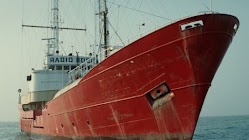
The first and most famous pirate radio station was Radio Caroline, which began broadcasting in 1964. It broadcast music from a ship which was moored in international waters, so it didn't come under British law. Over the next few years many other ships copied the pattern. This was a great annoyance to the BBC, when they realised that half of the population listened to the pirates. The only way the BBC could survive was by changing to meet the challenge. On September 30th 1967 the BBC started a new radio station,  which they called Radio One, that played pop music 24 hours a day. More than half of the DJs hired for the new station were pirate DJs, lured away from the cold north sea waters by big salaries. The most famous of the ex-pirate DJs now working for the BBC were Tony Blackburn and John Peel.

Radio One was greeted with great optimism, but it didn't mean the death of pirate radio. An official top 40 playlist was imposed for all weekday daytime broadcasts, so during the day only the current hits were played. This secured a large audience, but it wasn't enough to make everyone happy. To make things worse, there were soon holes in the Radio One broadcasts, mainly in the mid afternoon, when there were no Radio One broadcasts, supposedly because there was no interest in pop music at those times. The holes were filled by broadcasts from one of the BBC's other stations, Radio Two, which played easy listening and big band music. At these times the pop fans had to turn their dials back to the pirate stations.

I admit that I watched "The Boat that Rocked" today as a tribute to Philip Seymour Hoffman, who died from a drug overdose yesterday. In the film he plays a DJ called The Count, presumably based on Radio Caroline's Emperor Rosko. This is a terrific film with a great cast of actors, but the ones who stand out are Philip Seymour Hoffman and Rhys Ifans. I won't say anything about the film here, except that it takes place in 1966. Watch it! You won't regret it.

P.S. For some reason the film has been renamed "Pirate Radio" in America.

Philp and Rhys, friends forever

Rock and roll will never die!